
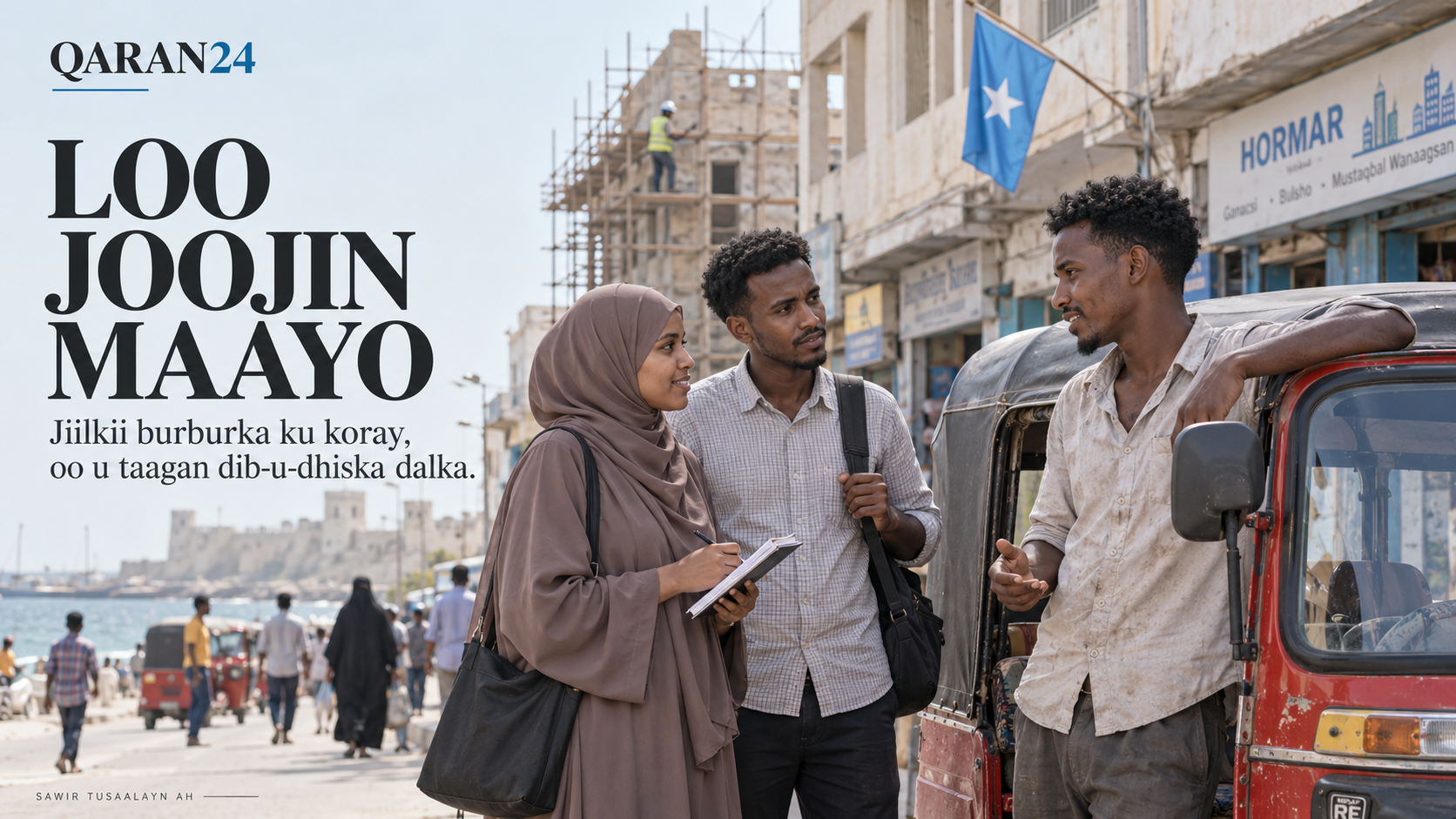
A statement of principles from Somali patriots who believe in “Loo Joojin Maayo” “We Will Not Be Held Back”—addressed to the Somali Future Council and the country’s political leaders.
We are the generation that grew up during the civil war. We learned what government means through its absence, and the value of security through fear, displacement, and lost opportunities.
When leaders could not agree to share power, our childhoods did not wait. Our education was interrupted, our families were displaced, and our parents carried burdens without public institutions to help shoulder them.
Today, we have jobs, families, education, and hopes worth protecting. We are prepared to defend our country’s progress through our voices, our writing, our work, and lawful civic participation.
“Loo Joojin Maayo,” the slogan under which we support President Hassan Sheik Mohamud’s leadership, represents a generational commitment: Somalia’s future cannot depend on securing every politician’s approval.
We Have Lived Through the Cost of Political Deadlock
Somalia’s history records numerous reconciliation conferences. A 2008 report by the U.S. Government Accountability Office documented at least 15 national conferences held since 1991. The Arta conference produced a transitional national government; the Kenya process of 2002–2004 produced the Transitional Federal Government. Yet those governments struggled to turn political agreements into effective authority on the ground.
That history taught us that agreements between leaders require the capacity to implement them, adequate resources, and functioning institutions. A communiqué gains value when it delivers security, services, and justice to the public.
To the Somali Future Council, we say: the future you invoke in your name also belongs to the generation raised amid collapse. It belongs to workers, students, mothers, and small business owners. Their needs deserve as much weight at the negotiating table as political leaders’ demands.
Young People’s Livelihoods Are Progress Worth Defending
The tuk-tuk driver who heads to work each morning is working to support a family. His earnings pay for food, rent, medicine, and education. Safe streets are essential to his livelihood.
Somali Public Agenda reported that more than 33,000 tuk-tuks were registered in 2023, while estimates at the time placed the number operating in Mogadishu at 40,000–50,000. A 2020 study of 400 drivers also found that more than 60% reported daily earnings of approximately 15–20. These figures are historical, but they show how important tuk-tuks are to employment and family livelihoods.
Young people, entrepreneurs, and their families built these opportunities through their own efforts. The government must protect their safety, support their ability to work, and shield them from abuse and unfair burdens.
We call on these young people—and everyone whose livelihood depends on a functioning city—to help protect its progress. The jobs they hold today and the opportunities they seek tomorrow require functioning government and lasting peace.
Why We Stand With Hassan Sheik
We support President Hassan Sheik Mohamud’s administration as it works to strengthen national capacity, security, and public institutions. We see his leadership as an opportunity to advance work that has long faced delays and political disputes.
There are verifiable achievements. In December 2023, Somalia secured approximately $4.5 billion in debt relief. This achievement resulted from efforts spanning three administrations, demonstrating what sustained national commitment can accomplish.
That same month, the United Nations Security Council lifted the arms embargo on Somalia’s federal government—an important step toward strengthening the country’s defense capabilities.
Mogadishu’s security improvements deserve protection and reinforcement. An assessment by the European Union Agency for Asylum reported fewer security incidents and fatalities in the capital between April 2025 and March 2026. It also documented Al-Shabaab’s territorial losses in other regions. These findings call on us to preserve these gains while honestly confronting the remaining challenges.
Our support rests on continuing effective work, correcting mistakes, and extending functioning government to people still waiting for it.
The Five Pillars of “Loo Joojin Maayo”
1. The nation’s interests come before individual interests.
Somalia belongs to all its people. Disagreements among leaders do not erase the government’s responsibility to protect citizens and provide services. A politician may oppose a decision; that opposition does not give them the authority to put everyone else’s future on hold.
2. Consultation must lead to decisions.
Grievances must be heard, and those denied their rights must receive justice. Consultation must have a process, a timeframe, and a conclusion. When someone says “looma dhama”—”not everyone is included”—they must identify who has been excluded, which rights have been denied, and how to correct the problem.
3. Agreements must be judged by their implementation.
We want agreements with timelines, funding, clear responsibility, and visible results. Security, public services, and jobs demonstrate whether a political agreement has benefited the people.
4. Those who demand delays must answer for their consequences.
Anyone calling for a national work suspension must clearly justify it, specify how long it should last, and offer a better alternative. The public deserves to know what it is waiting for and what that waiting will cost.
5. Support must rest on the rule of law and results.
We stand with the government as it rebuilds the country. We also demand accountability, protection of rights, and correction of mistakes. We want institutions that continue functioning when leaders change.
The Diaspora: Writing and Knowledge as National Contributions
We call on diaspora members who care about their country to support state-building through their knowledge, writing, investment, and connections.
They can explain verified achievements, correct misinformation, highlight opportunities, and contribute solutions drawn from their experience in Somalia and abroad.
Writing in defense of the nation is strongest when it is grounded in truth.
Somalia’s reputation is best defended through verifiable statements and work people can see.
Our Message to the Future Council and Political Leaders
If you have a better plan, present it to the public. If you identify a legal violation, substantiate it and pursue a process to address it. If people have been denied representation, identify them and explain how their rights can be restored.
We expect workable solutions, clear responsibility, and results. Somali politics must respect the public’s time, livelihoods, and aspirations.
Our generation has already paid the price of state collapse. Today, we stand ready to protect what we have built, strengthen what works, and create opportunities for our children that we were denied.
“Loo Joojin Maayo” is our commitment: let every voice be heard, let every mistake be corrected, and let the work of rebuilding the nation continue. Leaders may disagree, but Somalia’s future will not be held back.
