

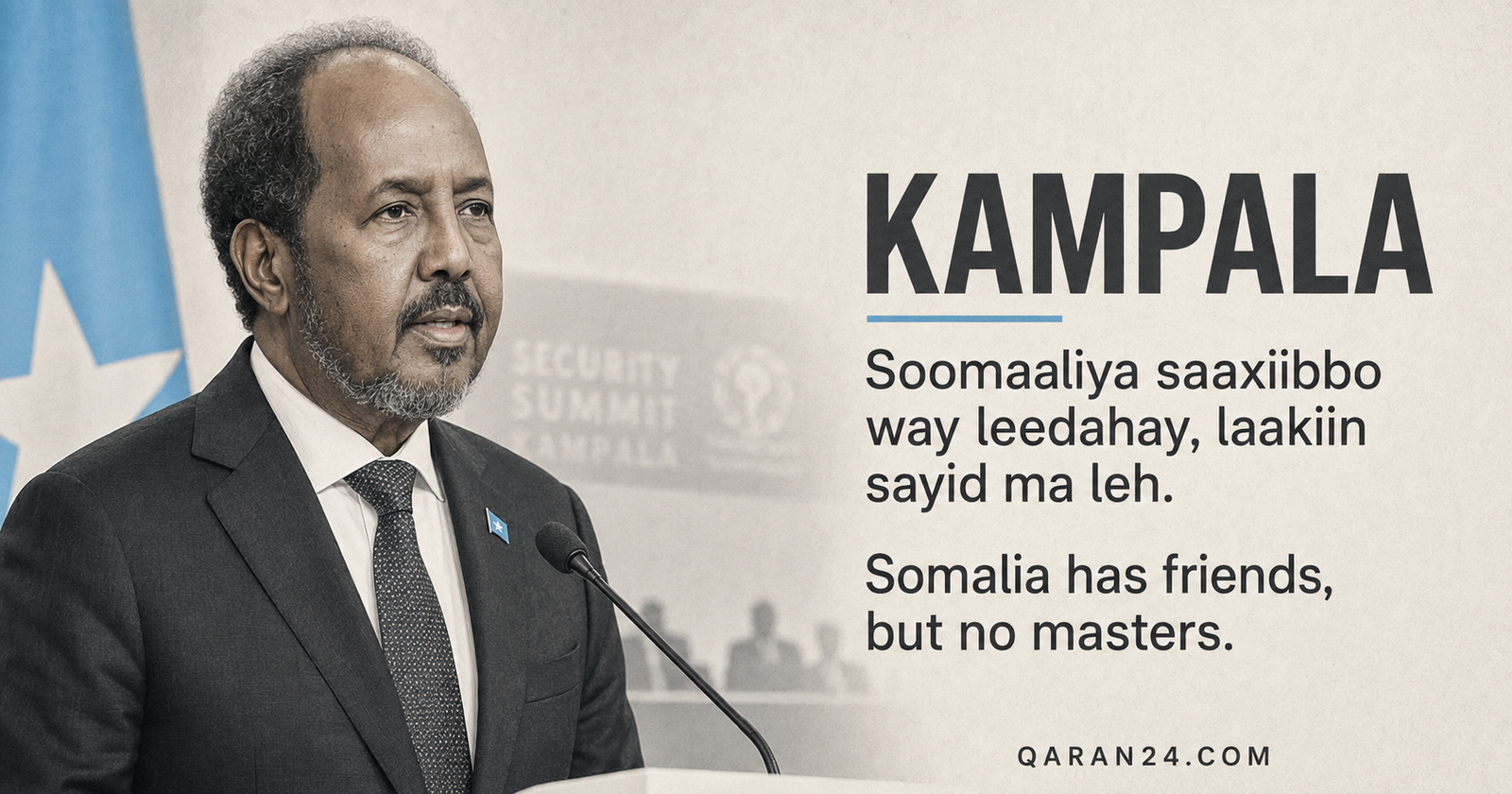
President Hassan Sheikh did not reject dialogue. He rejected the idea that Somalia’s internal politics should be managed through a foreign security summit.
Sometimes a single sentence captures what an entire nation has been feeling. At the AUSSOM summit in Kampala, President Hassan Sheikh Mohamud delivered one of those sentences: “Somalia’s domestic politics must not be internationalized or regionalized.”

The summit was convened to discuss Al‑Shabaab, AUSSOM’s financial crisis and the gradual transfer of security responsibilities to Somali forces. The discussion took a different turn, however, when Somalia’s internal political affairs appeared in the draft communiqué.
A day before the leaders met, Ugandan Defence Minister Kiryowa Kiwanuka called for political dialogue and reconciliation between Somalia’s Federal Government and Federal Member States. Dialogue itself is neither wrong nor unnecessary. The concern was that Somalia’s domestic political process was being discussed at a security meeting led by countries that have troops stationed inside Somalia. The Ugandan military published the minister’s remarks.
The original draft went further. It asked President Hassan Sheikh to convene a conference involving Somali political leaders and Federal Member State leaders, with heads of AUSSOM troop-contributing countries attending as observers.
When the Somali president responded, he did not reject dialogue or insult Uganda. He calmly reminded the meeting that it had been convened to address Al‑Shabaab, Somalia’s security situation and AUSSOM’s funding shortage. Somalia’s political disagreements, he said, must be handled through Somali processes.
It was a diplomatic rebuke without shouting or hostility. The clip quickly spread across social media and was welcomed by many Somalis at home and abroad. The reaction appeared to reach beyond the president’s usual supporters. People who disagree with Hassan Sheikh on domestic politics could still support the principle he defended in Kampala: Somalia can listen to its partners without surrendering its right to make its own decisions.
His intervention also produced a visible result. The final communiqué removed the specific request for a political conference attended by regional leaders as observers. It retained broader language supporting Somali unity, democratic governance and stronger national institutions. Dawan Africa documented the changes made to the final text
Uganda has supported Somalia’s security since 2007, and Ugandan soldiers have lost lives and suffered injuries fighting Al‑Shabaab. Somalis should never dismiss that sacrifice. But gratitude is not the transfer of sovereignty. A friend may help protect your home; that friend does not decide who meets inside it.
The defence minister’s remarks created unease among Somalis who have long viewed Ugandan troops as brothers and security partners. When a troop-contributing country begins to appear like a political referee, it can weaken trust between local communities, Somali forces and AUSSOM personnel. Kampala should therefore provide a clear diplomatic clarification—and acknowledge the concern caused by the way the proposal was presented.
Somalia has faced foreign military withdrawals before. American forces departed in 1994, and UNOSOM II ended in March 1995. Somalia did not disappear from the map. Even while the state had collapsed, Somalis built telecommunications companies, remittance networks and digital financial services that later became recognised across Africa. The World Bank has described Somalia as having one of the world’s most active mobile-money markets.
Nationalism does not require hostility toward foreign countries. It means respecting partners while defending the boundaries of national authority. Somalia wants cooperation and welcomes honest advice, but the final decisions concerning its internal politics belong to the Somali people.
The message from Kampala was larger than the summit’s communiqué: Somalia has friends, but it has no masters.


