

A Legal Opinion
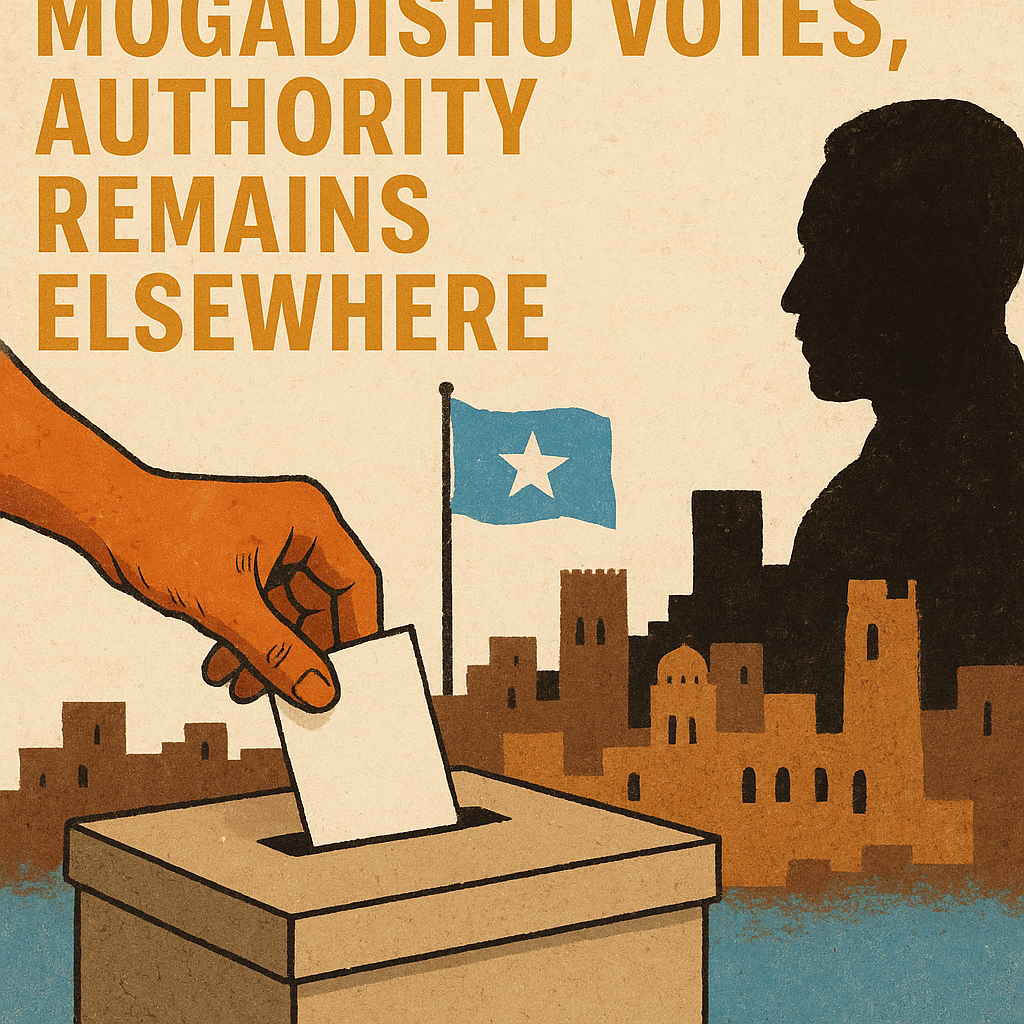
Local elections in Mogadishu are increasingly interpreted as evidence that the city has entered a phase of self-governance. This interpretation, however, rests on a legal misunderstanding. Elections determine representation, not constitutional authority. In Somalia’s legal order, authority is created by the Constitution and by legislation enacted under it, not by electoral outcomes.
Article 9 of the Provisional Constitution is decisive. It affirms Mogadishu as the capital but defers defining its legal status until Parliament enacts a specific law. That legislative act has not occurred. In the absence of such a law, Mogadishu has no autonomous constitutional standing. It is neither a federal member entity nor a self-governing capital district. Its governance, therefore, remains a federal responsibility.
Local elections cannot remedy this constitutional omission. They regulate the method of selecting officials, not the scope of their powers. When voters elect a mayor or district leadership, they authorise individuals to administer municipal functions within an existing legal framework. They do not confer independent governing authority. Legal competence flows downward only where the Constitution or statute explicitly provides for it.
In this sense, the electoral process produces ballots without autonomy. Citizens participate, choices are made, offices are filled, yet the substance of governing power remains elsewhere. This is why elections do not equal power, even when they are free, competitive, and widely accepted.
This explains the limited authority of an elected mayor. Without a capital status law, the mayor exercises delegated administrative powers rather than original constitutional powers. The office operates within the federal administrative structure and remains subject to federal supervision, financial control, and policy direction. Electoral legitimacy does not alter this legal hierarchy.
The consequences are most evident in public finance. Authority over budgeting, taxation, and revenue allocation requires explicit legal attribution. No such attribution exists for Mogadishu. As a result, fiscal control remains with the Federal Government. An elected mayor may articulate policy priorities and electoral pledges but cannot lawfully implement them without federal authorisation. Political accountability is therefore decoupled from legal capacity.
This arrangement reveals a deeper tension in the democratic design. What emerges is democracy on paper, authority in limbo. The procedures of democracy function, but the institutional settlement required to give them full effect remains unresolved.
Mogadishu’s local elections thus embody a form of procedural democracy without corresponding institutional autonomy. They are constitutionally permissible and politically significant, but legally constrained. Their limitations do not arise from electoral design but from the prolonged failure to implement Article 9.
Until Parliament defines the capital’s legal status, local elections will continue to operate within a framework of federal dominance. Representation will exist without self-government, and accountability without control. Recognising this distinction is essential for accurate public understanding and for any serious discussion about democratic reform in the capital.


