

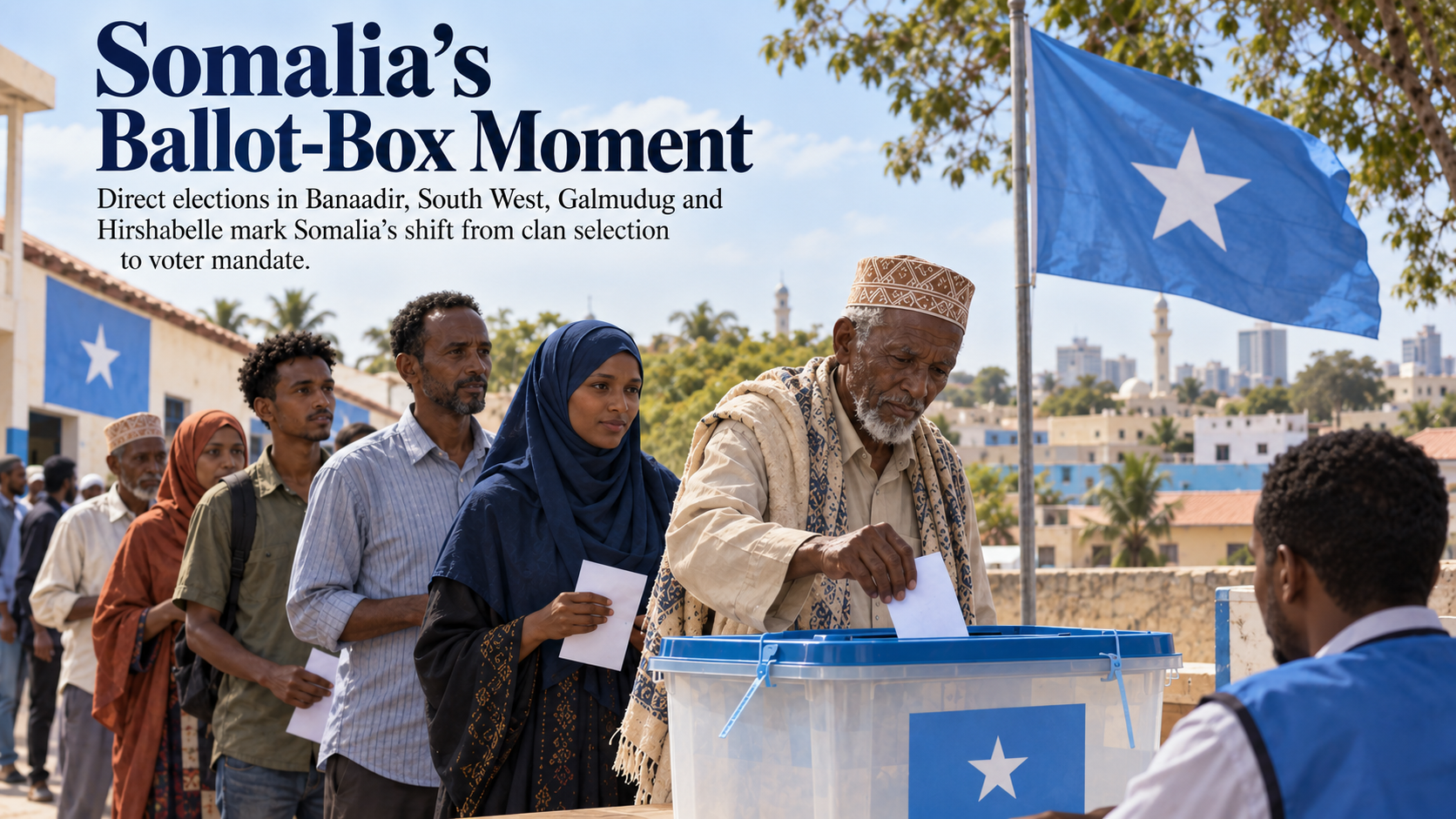
Mogadishu, Somalia — In parts of Somalia, a political shift is underway, with ordinary citizens now voting directly for representatives, marking a historic change after decades of civil war and clan-based power sharing.
Direct elections are being held in Banaadir, South West, Galmudug, and Hirshabelle, gradually testing a new model of political authority in a country where the post-war political system has historically depended on clan-based power sharing, indirect elections, and negotiations among political elites and Somali clan elders.
The importance of these elections extends beyond who wins the seats. At the local and state levels, the principle being tested is that representatives should derive their mandate from voters rather than being chosen primarily through clan arrangements. For Somalia, this represents a potentially significant shift in the relationship between citizens and political power; this is a new test for Somalia’s political system.
From Clan-Based Negotiations to the Ballot Box
Somalia’s clan-based political system emerged partly in response to the collapse of the central government and years of armed conflict. It provided communities a way to negotiate representation when national democratic institutions were weak or nonexistent. However, this system often left ordinary citizens with little direct influence over their representatives.
In Somalia today, direct elections challenge the status quo arrangement. Instead of relying on a small number of elders, politicians, or power brokers to negotiate representation, candidates must now persuade individual voters. While clan politics hasn’t disappeared and clan identity remains deeply embedded in Somali political and social life, direct elections introduce another source of political legitimacy: the individual voter.
Many Somali voters find this direct participation deeply personal. For example, Malaaq Ali in Diinsoor said he hoped his children’s political future would be determined by their own choices, not clan elders.
In Cabudwaaq, Galmudug state of Somalia, voters said Jama compared the election process to Somalia’s history of armed political conflict. He recalled a time when political disputes were settled through gun violence, with leaders prioritizing their own interests. Now, he proudly explained that he was using a ballot to select the representative he wanted, symbolizing hope for peaceful change.
This contrast supports one of the broader arguments made by supporters of direct elections: that political competition through ballots can gradually diminish the importance of political competition conducted through force.
An 89-Year-Old Voter Bridges Two Political Eras
One of the most striking accounts came from Jowhar. A voter named Mohamed Xaayow, 89, recounted having voted in Somalia in 1964. More than six decades later, after experiencing military rule, state collapse, civil war, and years of indirect political representation, he had the chance to cast a ballot once more.
Xaayow’s story links two very different periods of Somali political history. He noted that he was no longer voting solely based on clan affiliations but was choosing a political organization that he said was beyond his imagination. He expressed hope in generational terms, explaining that after everything his generation had endured, younger Somalis would finally be able to vote for themselves. This symbolism offers hope for a more participatory future.
Why Local Elections May Matter More Than National Speeches
Local elections matter more because they directly affect issues like security, roads, and services, changing how citizens interact with their representatives and the state.
A representative who once relied mainly on political brokers or clan support may increasingly need to consider a new question: Will voters support me again? This dynamic creates the potential for greater accountability. Voters can evaluate whether their representative delivered services, improved security, or vanished after being elected.
Over time, this could encourage politicians to prioritize performance. The implications extend to state politics as well. If direct voting becomes established at the state level, it may gradually alter how regional political power is organized. The traditional question of which clan receives a particular position could begin to compete with another: which candidate can win the most votes?


