

Analysis by a Somali Insider
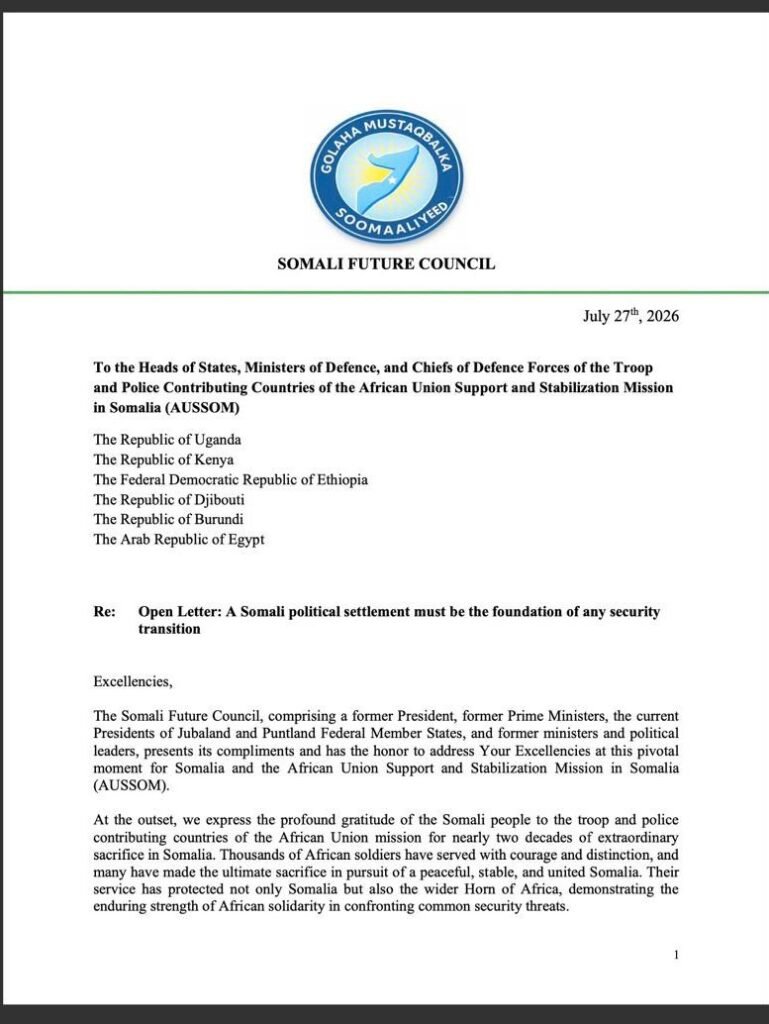
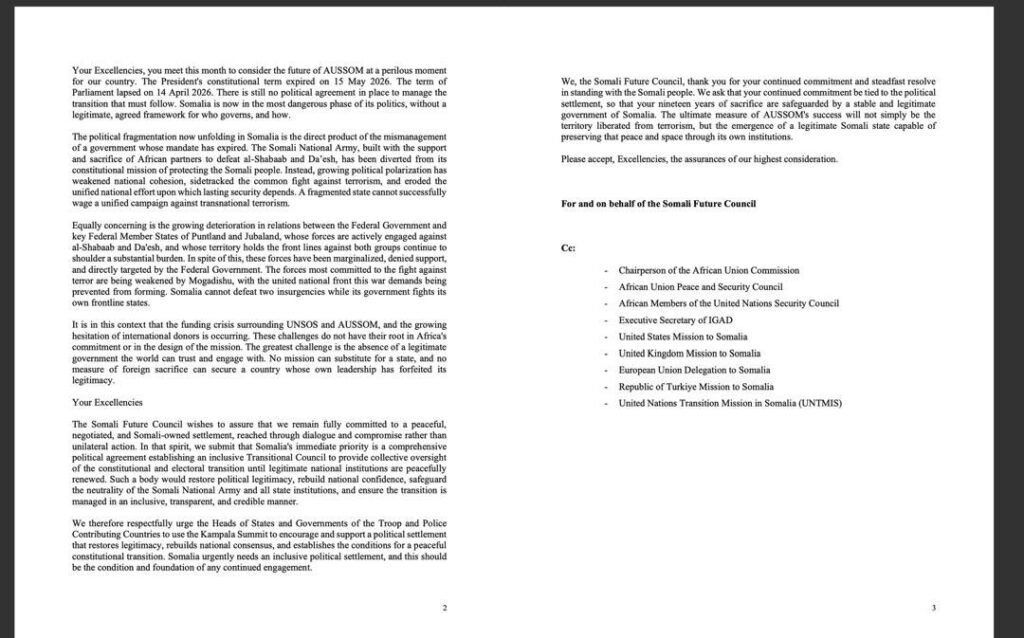
An open letter sent by the Somali Future Council to countries contributing troops and police to the African Union Support and Stabilization Mission in Somalia AUSSOM, has opened a new chapter in Somalia’s political confrontation.
The letter, dated July 27, 2026, was addressed to the leaders, defence ministers and military chiefs of Uganda, Kenya, Ethiopia, Djibouti, Burundi and Egypt. Copies were also sent to the African Union, IGAD, African members of the UN Security Council, the United States, the United Kingdom, the European Union, Türkiye and United Nations missions.
On the surface, the Council’s message appears straightforward: Somalia’s security transition should rest on a Somali-owned political settlement. Read more closely, however, the letter asks for much more than dialogue. It invites foreign governments to pressure the Federal Government and support the creation of a Transitional Council with authority over constitutional and electoral processes.
That leaves Somalia with a fundamental question: whom does the Somali Future Council represent, and who authorised it to speak for the Somali people before foreign governments?
Influential politicians without a national electoral mandate
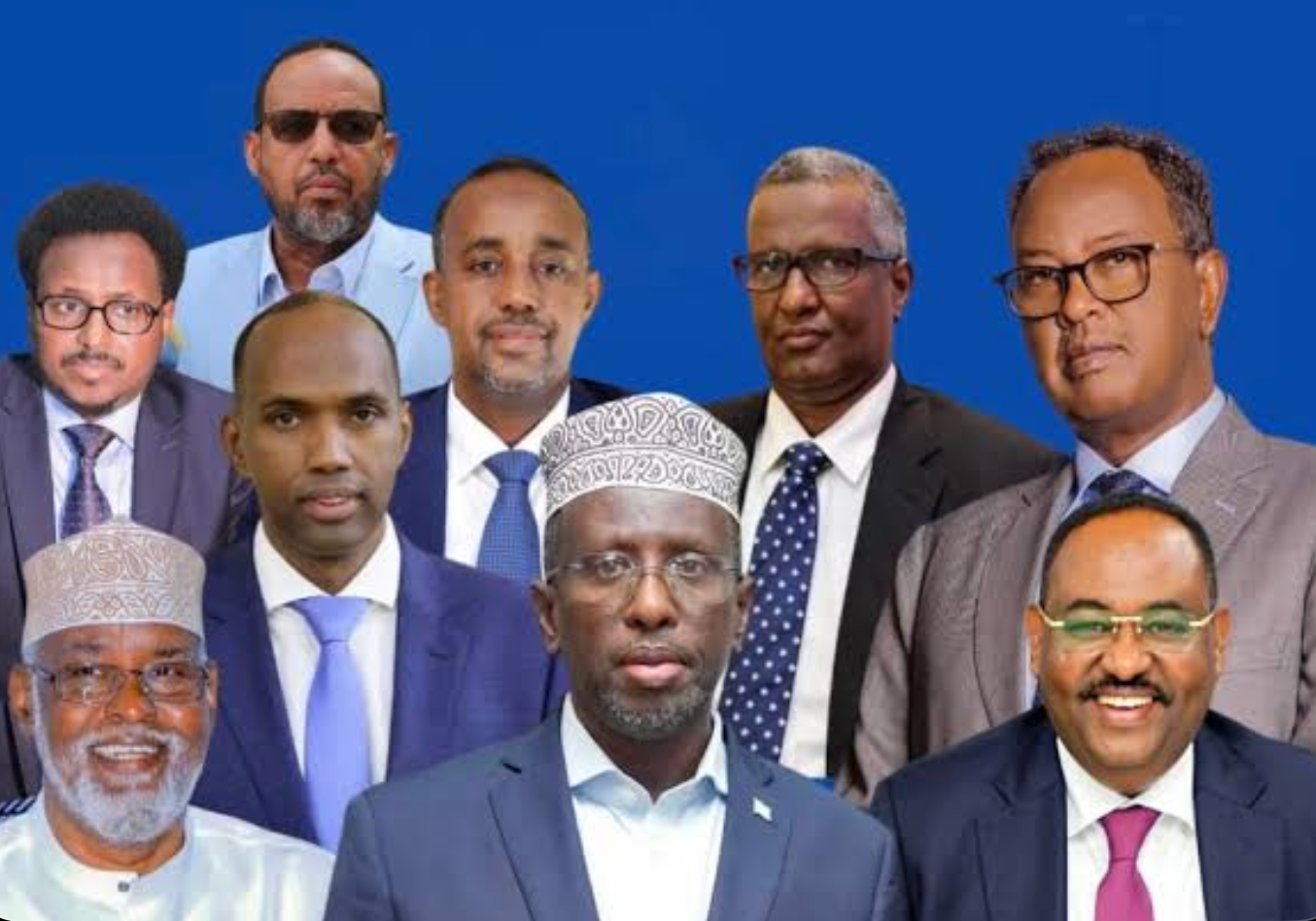
Established in October 2025, the Somali Future Council brings together Puntland President Said Abdullahi Deni, Jubaland President Ahmed Mohamed Islam—widely known as Ahmed Madobe—former President Sharif Sheikh Ahmed, former prime ministers and other opposition politicians.
Its meetings have included Hassan Ali Khaire, Mohamed Hussein Roble, Abdi Farah Shirdon and Abdirahman Abdishakur Warsame. These are not marginal personalities. Some have led Somalia, while others continue to govern federal member states. Their voices cannot simply be dismissed.
Political influence, however, is not the same as democratic representation.
The Council has not demonstrated its national support through a direct public vote. Its Mogadishu-based members exercise no executive or military authority in the capital. Jubaland’s effective administrative presence is concentrated largely in Kismayo and limited surrounding areas. Puntland controls a broad territory but faces internal political disputes, security pressures and economic constraints of its own.
The Somali Future Council is therefore an important opposition coalition, but it is not an elected national institution representing the entire Somali population.
Its members have every right to organise, criticise the government and contest elections. What opposition status should not provide is a permanent veto over the right of ordinary Somalis to choose their leaders.
What is the letter really requesting?
The Council’s letter makes three significant demands.
First, it asks AUSSOM troop-contributing countries to link their security commitment to a new political settlement.
Second, it calls for an inclusive Transitional Council to oversee constitutional reform, elections and the renewal of national institutions.
Third, it accuses the Federal Government of politicising the Somali National Army and other state institutions. It also argues that Puntland and Jubaland forces—alongside Somali National Army units fighting on the front lines—have not received adequate support in their battles against Al-Shabaab and Islamic State militants.
These are serious allegations. If supported by evidence, they deserve independent investigation. The letter itself, however, offers limited evidence to substantiate the full range of its claims.
More troubling is its attempt to connect an internal electoral dispute to the future of an African counterterrorism mission. That risks turning security assistance into political leverage designed to force the Federal Government to accept opposition demands.
Political disagreements should be resolved through negotiations, constitutional institutions and elections. The safety of soldiers fighting Al-Shabaab should not become a bargaining chip in an elite political contest.
Two visions competing for Somalia’s future
Somalia’s present dispute is larger than a rivalry between Villa Somalia and a group of established politicians. It reflects two competing visions of how political authority should be obtained.
The Federal Government argues that Somalia must leave behind its indirect system, in which clan elders, selected delegates and negotiated quotas determined who entered Parliament. It wants to replace that model with universal suffrage.
On December 25, 2025, Mogadishu held its first direct local election since 1969. More than 900,000 people were reportedly registered, although opposition groups criticised the process as unilateral and lacking sufficient political consensus.
Direct electoral processes have also been conducted or prepared in parts of South West State, while political organisations and public campaigns have expanded across Galmudug State. and now also schedule to Hirshabelle State. Whatever one thinks of the government, one-person-one-vote is no longer merely a slogan. It is beginning to acquire practical machinery: voter registration, political organisations, candidates, polling arrangements and public campaigns.
The Somali Future Council argues that constitutional and electoral reforms require a broad political agreement and should not be shaped by the Federal Government alone.
That concern deserves to be heard. An election without genuine competition, public confidence or independent oversight could deepen Somalia’s crisis as many people claim . A vote whose outcome has already been arranged is not democracy simply because ballot boxes are present.
But disagreement among politicians cannot become a permanent excuse for preserving a system that excludes most citizens from decisions about their own country.
Who benefited from the indirect system?
The indirect model concentrated power among elders, delegates, federal-state leaders, politicians and wealthy financiers. Ordinary citizens had no meaningful vote. They watched as their political future was negotiated in hotels, private homes and meetings held behind closed doors.
The system encouraged vote-buying and created space for opaque domestic and foreign financing to determine who entered Parliament. In practice, the Somali citizen became a spectator while political brokers negotiated in the citizen’s name.
Universal suffrage will not automatically eliminate clan politics, corruption or foreign interference. But it forces politicians to leave private negotiating rooms, face the public and ask for their votes.
That is not a perfect democracy. It is still a meaningful step toward one.
Progress should be questioned but not erased
The Council’s letter presents a country defined mainly by political fragmentation. It offers little acknowledgement of Somalia’s institutional, economic and social progress.
The World Bank says Somalia has made notable advances in institution-building, economic reform and public financial management, even as insecurity, poverty, climate shocks and reductions in foreign assistance continue to threaten those gains. It projects economic growth of 2.8 percent in 2026 and 3.1 percent in 2027.
Mogadishu remains vulnerable, and no serious observer would pretend otherwise. Yet commercial activity, construction, investment and public life have visibly expanded. A city once known almost entirely through images of destruction is gradually recovering the rhythm of a functioning capital
Recognising this progress does not require silence about the government’s failures. Equally, opposing the government should not require denying every national achievement.
International partners should demand transparent elections, constitutional legality, political freedom and protection for opposition leaders. The opposition should face equally serious questions: What is its alternative program? Who authorised it to speak for the population? How would its proposed Transitional Council avoid becoming another mechanism for distributing positions among the same established politicians?
Accountability cannot be a one-way street.
Why does the international community engage the Council?
Foreign governments do not necessarily engage the Somali Future Council because it has demonstrated majority public support. They engage it because Somalia remains a fragile federation, and because Puntland and Jubaland carry geographic and security importance.
Donors fear that a political confrontation could weaken the campaign against Al-Shabaab or trigger wider instability. That concern is understandable.
Yet the international search for short-term stability has repeatedly returned Somalia to the same political starting point. Whenever national institutions attempt a major transition, external actors call for another elite settlement. Those capable of obstructing the process consequently receive more political weight than citizens prepared to vote peacefully.

International partners should facilitate dialogue, but they should not become the final referees of Somali politics. Somalia’s future must rest on its constitutional institutions and, ultimately, the will of its people, not the approval of foreign embassies
Claims that opposition politicians are controlled by Gulf governments, or that foreign states deliberately seek to keep Africa unstable, should not be published as established facts without credible evidence. Foreign influence and political financing are legitimate subjects of investigation, but suspicion is not proof.

The answer is transparency: government and opposition figures alike should disclose who finances their political activities and what commitments accompany that support.
Dialogue, yes a permanent veto, no
Comparisons with Sudan have clear limits. The Rapid Support Forces are an armed paramilitary organisation engaged in a devastating war, whereas the Somali Future Council is a lawful political coalition containing federal-state presidents and former national leaders. Somalia’s government cannot treat political opponents as Sudan treats an armed belligerent.
One principle nevertheless remains relevant: negotiations should not give an unelected coalition authority superior to national institutions.
Dialogue should improve electoral rules, open political space, reduce tensions and protect opposition rights. It should not become a process through which state institutions are dismantled whenever influential politicians reject the direction of reform.
Improve direct elections do not abandon them
The Federal Government carries the greater responsibility because it controls national institutions. It must ensure that forthcoming elections are secure, transparent, genuinely competitive and independently monitored.
Opposition parties must be free to organise, campaign, nominate candidates, observe voting and challenge irregularities through credible institutions. If the government controls the candidates, electoral administration and final results, one-person-one-vote will become an attractive phrase emptied of meaning.
The Somali Future Council must also move beyond conferences and letters addressed to foreign capitals. If its leaders believe they command public support, they should build political parties, present a clear national program, nominate candidates and face Somali voters.
Somalia does not need its opposition silenced. Nor should state institutions be surrendered to every coalition capable of causing political disruption. The country needs an accountable government, a responsible opposition, laws that stand above individuals and citizens whose votes carry real weight.
Political agreement matters. But an agreement that gives citizens no vote is an agreement among politicians—not a national settlement.
The international community should help Somalia move forward instead of repeatedly returning it to the political arrangements it is trying to escape. The present government should be pressured to improve direct elections, not abandon them. Somalia should be supported in completing its democratic transition, strengthening the campaign against Al-Shabaab and building institutions that will outlast today’s leaders.
Somalia’s future should not be settled through letters sent to foreign capitals.
It should be decided by the Somali people at the ballot box.


