

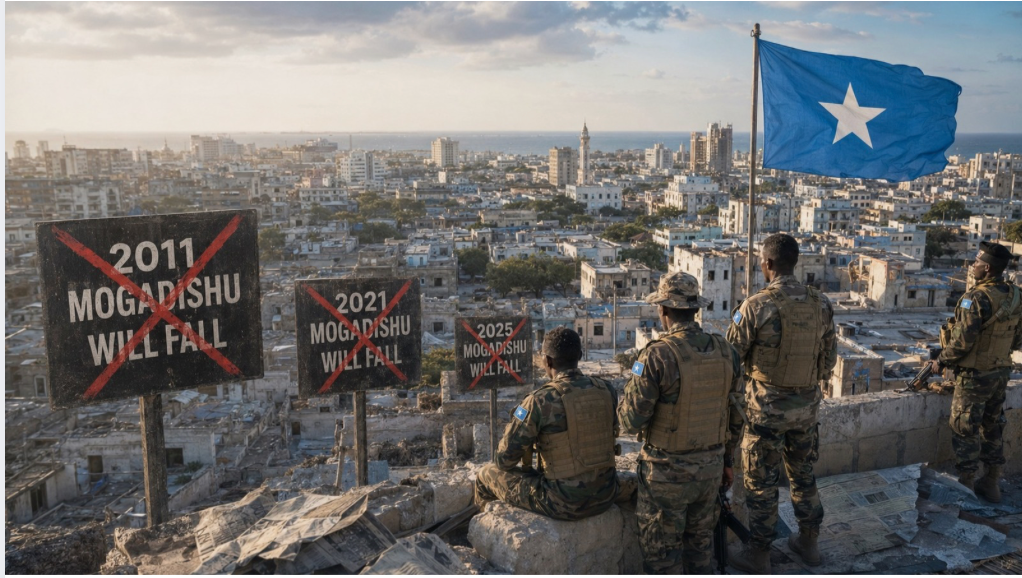
For more than three decades, some security analysts based both inside and outside Somalia have consistently underestimated the resilience of the Somali people and the capabilities of the Somali Security Forces. Whether deliberately or unintentionally, they have adopted and amplified Al-Shabaab’s narrative, repeatedly predicting that Mogadishu, the nation’s capital, would fall into the group’s hands.
One of the clearest examples can be found in the reports and media coverage published during Al-Shabaab’s major Ramadan offensive in 2010. On the morning of August 23, 2010—the twelfth day of Ramadan—the group launched a large-scale assault that it called “The End of the Aggressors.” Somalis commonly remember it as the Battle of Ramadan.

At the time, Al-Shabaab controlled approximately 70 percent of Mogadishu. The Transitional Federal Government, led by President Sheikh Sharif Sheikh Ahmed, held little more than the presidential compound, the airport and the road connecting those two locations.
Western media outlets and analytical institutions subsequently published a stream of reports and forecasts that appeared to favor Al-Shabaab’s narrative. They argued that the Somali government was close to disappearing altogether. On August 24, 2010, The New York Times published a widely circulated report by prominent journalist Jeffrey Gettleman titled “At Least 30 Killed in Attack on Hotel in Somalia.”
Gettleman examined the deadly attack carried out by two Al-Shabaab suicide attackers against the Muna Hotel near the presidential compound. He argued that the assault exposed the city’s true trajectory and demonstrated the Somali government’s vulnerability, describing the weak administration as being only a few steps away from total collapse.
Gettleman was among the journalists and forecasters who appeared to accept Al-Shabaab’s claim that it needed only one week to capture Mogadishu.
Reuters and the BBC also published several reports describing the Transitional Federal Government as besieged and confined to a handful of positions. Their coverage drew on assessments by the International Crisis Group, which predicted that the capital was close to falling entirely under Al-Shabaab’s control.
The private intelligence and geopolitical analysis firm Stratfor likewise issued a security assessment claiming that this al shabaab offensive was intended to deliver the final blow that would eliminate the government based at Villa Somalia.
Yet after an entire year of intense fighting, the outcome was the opposite of what had been predicted. On August 6, 2011, the same Western media outlets and journalists who had forecast Mogadishu’s fall including Gettleman reported that Al-Shabaab had been driven out of the Somali capital.
Since then, however, these analysts appear to have learned little from that episode. Every few years, they return to the same flawed prediction: that Al-Shabaab is on the verge of taking over Somalia.
For example, when the Taliban seized Afghanistan in August 2021, international media outlets and analytical institutions published several articles directly comparing Kabul with Mogadishu. They predicted that the Somali government could collapse just as the Afghan government had if international forces withdrew from the country.
Similarly, the fall of Bashar al-Assad’s government in Syria in December 2024 prompted Western analytical institutions—including the Horn Institute—to draw comparisons between Somalia and Syria. Their reports argued that if international forces withdrew, the Somali government might collapse within days, just as the government in Damascus had done.
Once again, following Al-Shabaab’s offensive in early 2025 and its capture of Adan Yabaal, commentators predicted that the Somali government would not survive that year.
For years, Al-Shabaab has promoted the claim that it could capture Somalia within days if foreign forces withdrew. Western media outlets have repeatedly amplified this narrative.
That claim, however, was challenged and disproved by the Somali government’s 2022–2023 offensive against Al-Shabaab in the central regions. Not a single AMISOM soldier participated in that campaign. Although the offensive suffered from serious strategic and organizational shortcomings, it nevertheless inflicted significant losses on the militants. Large areas were recovered, and numerous senior Al-Shabaab commanders were killed.
The campaign’s greatest achievement was that it shattered the long-repeated narrative that the Somali government would not survive the departure of AMISOM. It also broke through the wall of fear created by the belief that Al-Shabaab could not be defeated or pushed back.
The question that must therefore be asked is: Who benefits from these predictions, and whose interests do they serve?
It is clear that such forecasts serve economic and political interests that depend on Al-Shabaab’s continued existence. First, they support security projects funded in the name of fighting terrorism. Western analytical institutions and security contractors need the Al-Shabaab threat to be continually exaggerated and portrayed as capable of capturing the capital at any moment. This helps sustain funding and multimillion-dollar budgets allocated to “counterterrorism” programmes.
Second, these predictions directly benefit Al-Shabaab, which uses them as propaganda and psychological warfare. The group cites failed Western forecasts to undermine public confidence, spread fear throughout society and weaken the morale of the courageous soldiers serving on the front lines.
Somalia’s security and destiny, however, do not depend on predictions written behind desks and driven by financial interests. They depend on the blood, courage and sacrifice of the Somali National Security Forces—and on the unbreakable determination of the Somali people.
Aw Dacar
Journalist and author writing on social affairs, security and state-building.This article was written by Aw Dacar. All rights belong to the author.


