Somalia’s African Union mission is under financial pressure just as Türkiye is becoming one of the country’s most important long-term security partners. That makes the growing campaign against Ankara’s presence more than a political dispute. It can directly benefit Al-Shabaab.
By Osman Omar
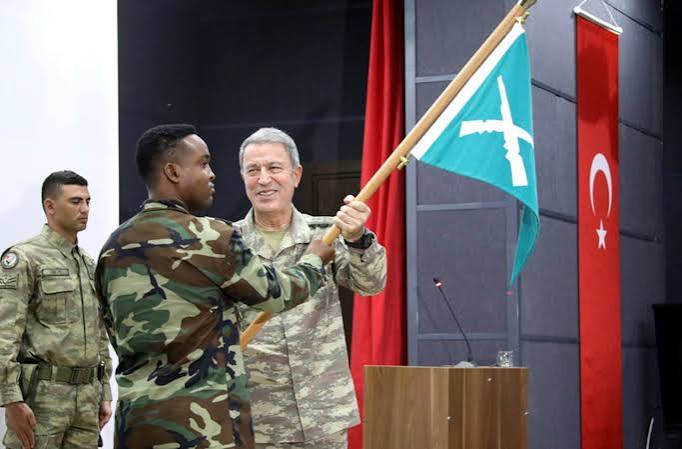
MOGADISHU — The debate over Türkiye’s role in Somalia is happening at a particularly sensitive moment. The African Union mission supporting Somalia’s fight against Al-Shabaab is under financial strain. AUSSOM has faced repeated warnings about funding shortages, while Somalia is still fighting an insurgency that has survived nearly two decades of military pressure. At the same time, Türkiye is becoming more deeply involved in Somalia’s security. It trains Somali soldiers, supports defense institutions, and is involved in maritime security. Its military presence has grown, and its economic and energy interests suggest that Ankara is not treating Somalia as a temporary commitment.
If one of Somalia’s main multinational security arrangements is struggling financially while Türkiye is becoming more deeply embedded, Ankara naturally becomes more important to the country’s security architecture. And that makes it more important to target Turkiye . Not only on the battlefield. In the information space on behalf of al shabaab.
Al-Shabaab Knows How to Wait
Al-Shabaab hass survived for years because it understands something that many foreign interventions underestimate: “buying me. “. Military campaigns come and go Foreign troops arrive Offensives begin Towns are captured Political leaders announce victories Then funding becomes uncertain Governments change International attention moves somewhere else Military pressure slows Al-Shabaab waits When the opening appears, it tries to move back in. Türkiye presents a different is kind of problem for them because of consistency.
Türkiye is not simply deploying forces to Somalia for a short-term mission. Ankara has built a much deeper relationship through military training, defense infrastructure, maritime security, and expanding political and economic cooperation. Those long-term investments give Türkiye both the capacity and the incentive to remain engaged.
From Al-Shabaab’s perspective, this is a serious strategic threat. The group has historically benefited from weak institutions, limited security capacity, and gaps in state authority. A durable international partner that helps Somalia strengthen its armed forces and state institutions gradually erodes those conditions.
That is why Türkiye’s presence matters far beyond the number of Turkish soldiers, drones, aircraft, or naval vessels operating in Somalia. The greater challenge for Al-Shabaab is not any single deployment or weapon system. It is continuity: the prospect of sustained Turkish support helping Somalia build stronger institutions and security capabilities over many years.
You Do Not Have to Work for Al-Shabaab to Help Al-Shabaab
This is where the argument becomes uncomfortable.A person need not be a member of Al-Shabaab to help create an outcome that benefits Al-Shabaab. also a politician does not need to take orders from the group. A journalist does not need secret contact with militants. A civilian sharing a misleading image may have no connection to extremism at all. But intention and result are not always the same thing. Someone may spread a false claim because they dislike the federal government. Someone else may repeat it because it is politically useful.A media outlet may publish it because it attracts attention. A civilian may forward it because it looks convincing. None of these people necessarily supports Al-Shabaab. But if the result is that Somalis lose confidence in one of the most important security partners helping the government fight the group, then Al-Shabaab benefits. That is the point. The person spreading the message may not be working for Al-Shabaab. But the message can still be working for Al-Shabaab’s interests.
Why the Timing Matters
This would matter even if AUSSOM were fully funded and expanding.
But it matters more now because the mission itself is facing financial uncertaint . Somalia remains heavily dependent on international security support as it seeks to build a stronger national army.
If one part of that support system weakens, the partners that remain committed become more valuable.
Türkiye is one of those partner . So weakening Türkiye’s legitimacy inside Somalia does not happen in a vacuu . If Ankara becomes politically toxic, the Somali government loses room to cooperate with it.
If every Turkish military action is surrounded by suspicion, future operations will be harder to explain.
If every unexplained explosion is immediately described as a Turkish strike, public trust starts to erode.
If small protests are presented as proof that the country has turned against Türkiye, the political cost of the relationship grows.
That outcome has an obvious beneficiary. and that is Al-Shabaab and Piracy
Al-Shabaab’s indirect propaganda campaign began with the image circulated on August 29.
On August 29, an image involving Somali children and Turkish flags circulated widely online.
The image quickly became more than just an image. It was used to support a broader argument about Turkish influence in Somalia, with some people presenting it as evidence that Somali children were being used for political messaging. This is exactly the kind of material that spreads quickly.
Children create emotion. Flags create emotion. Questions about national dignity create emotion.
By the time people begin asking whether the image is authentic, where it came from, or whether the caption is accurate, the story may already have reached thousands of people.
That is where OSINT matters.
You work backward.
Where was the image first posted?
Who uploaded it?
Is there an original file?
Are there earlier versions?
Is there video from the same scene?
Was the image altered?
Was it generated?
Does the caption match what actually happened?
These questions are slower than outrage.
But they are how you get to the truth.
And the difference matters because even a real photograph can be used dishonestly.
A genuine image can carry a false caption.
A real event can be stripped of context.
A single frame can tell a story that the full video cannot.
So the question is not only “Is this image real?”
The better question is: Is the story built around it true?
Then Came Doolow
A few days later, the dispute became much more serious.
An explosion occurred at a residence in Doolow, near Somalia’s border with Ethiopia.
Almost immediately, claims appeared that a Turkish drone had carried out the strike.
The accusation spread quickl . But explosions leave evidence.
If a missile- or drone-delivered weapon hits a building, investigators can look for an impact point, munition fragments, crater patterns, fragmentation, penetration, and the direction of the blast.
An explosion that begins inside a building can leave a very different pattern.
That is why forensic evidence matters.
A damaged building is not proof of a drone strike.
Smoke is not proof of a missile.
A loud explosion is not proof of an air attack.
And thousands of people repeating the same claim do not make the claim true.
The question should be simple:
What does the evidence show?
That standard should apply to everyone.
If the government explains, it should provide evidence.
If opposition figures accuse Türkiye, they should provide evidence too.
Politics should not lower the standard.
Then Came the Burning Flags
By September 6, another set of images was circulating.
This time, people in parts of Somalia were shown burning Turkish flags.
The videos looked dramatic online.
But social media is very good at making small events look large.
A tightly framed video of a small crowd can fill an entire screen.
Dozens of accounts can then repost that same video.
Hundreds of thousands of people may see it.
The audience becomes huge.
The protest itself may still be small.
That distinction matters.
A video can show that a protest happened.
It cannot automatically tell us who organized it, who paid for it, or whether an extremist group was involved.
Those questions require evidence.
Who called people to the protest?
Who promoted it?
Who arranged transportation?
Were participants paid?
Were politicians involved?
Did different protests use the same slogans?
Which accounts received the footage first?
Which networks pushed it afterward?
Those are legitimate OSINT questions.
But even before all of them are answered, one thing is obvious.
Images of Somalis burning Turkish flags are useful to Al-Shabaab.
The group has spent years trying to portray Somalia’s foreign security partners as enemies, occupiers, or outsiders.
It does not need to organize every protest to benefit from the picture.
Sometimes the image itself is enough.
Political Motives Can Still Produce Strategic Effects
Imagine a politician who strongly opposes the federal government.
He spreads an allegation against Türkiye because he believes damaging Türkiye will also damage officials in Mogadishu.
His motive may be political.
Al-Shabaab’s motive is different.
It seeks to weaken the Somali government and the security structures that support it.
But the outcome can point in the same direction.
Or imagine a media outlet publishing an explosive allegation to boost traffic.
Its motive may be attention, influence, or money.
But if the result is that thousands of Somalis begin believing that an important security partner is attacking them, Al-Shabaab gains from the confusion.
This is why people can become unwitting amplifiers.
They do not need to support the group.
They do not even need to like the group.
They only need to spread something that helps create the conditions Al-Shabaab wants.
That is how modern information warfare works.
The Real Target Is Trust
If Türkiye becomes unpopular enough, its relationship with Somalia becomes harder to sustain.
That is where information can create a strategic effect.
Every operation becomes controversial.
Every agreement becomes suspicious.
Every Turkish deployment becomes a political argument.
Every explosion becomes a possible accusation.
The aim does not have to be convincing every Somali that Türkiye is an enemy.
Creating doubt can be enough.
Maybe Türkiye is hiding something.
Maybe the government is not telling the truth.
Maybe those soldiers are here for another reason.
Maybe that explosion was really a Turkish strike.
Repeat enough uncertainty, and people begin to lose confidence even when no single accusation has been proven.
That is why the real target may not be a Turkish drone or military base.
It may be public trust in the partnership itself.
That Does Not Put Türkiye Above Criticism
There is an important line here.
Türkiye should be questioned when warranted.
So should AUSSOM.
So should the United States.
So should the Somali government.
If a Turkish military operation harms civilians, investigate it.
If a contract is unfair to Somalia, expose it.
If a defense agreement raises legitimate sovereignty concerns, debate it.
If evidence shows wrongdoing, publish it.
That is accountability.
But there is a clear difference between accountability and fabrication.
A false drone-strike claim is not accountability.
A manipulated image is not accountability.
A small protest presented as the voice of an entire country is not accountability.
Those things shape perception.
And when they repeatedly weaken a security partner that helps contain Al-Shabaab, the effect becomes strategically significant.
Ask the Simplest Question: Who Benefits?
Al-Shabaab wants weaker Somali security forces.
Türkiye trains Somali security forces.
Al-Shabaab benefits from gaps in surveillance and military pressure.
Türkiye helps strengthen those capabilities.
Al-Shabaab benefits when Somalia’s institutions are weak.
Türkiye is investing in those institutions.
Al-Shabaab benefits when Somalia is isolated from committed security partners.
Türkiye is becoming more deeply committed.
The strategic picture is not difficult to understand.
Anyone deliberately manufacturing false narratives designed to push Türkiye out of Somalia is pursuing an outcome that Al-Shabaab itself would welcome.
That does not automatically make that person an Al-Shabaab operative.
But it does mean that what they are doing can serve Al-Shabaab’s strategic interests.
And that distinction matters even more when AUSSOM is struggling with money.
Somalia Is Fighting Two Wars
One war is visible.
Soldiers.
Drones.
Explosions.
Roads.
Territory.
The other war moves through phones.
Images.
Rumors.
Political speeches.
Anonymous accounts.
Short videos.
False claims repeated until they begin sounding familiar.
Türkiye’s growing role may be making the physical battlefield harder for Al-Shabaab.
That gives the group and anyone whose interests overlap with its objectives more reason to fight over the political environment instead.
Somalis do not have to agree with every Turkish policy to understand that.
They only have to insist that accusations be supported by evidence.
Real criticism strengthens Somalia.
Fabrication does not.
And when false narratives are used to undermine an important security partner at a time when AUSSOM is already facing financial uncertainty, the strategic beneficiary is not difficult to identify.
Al-Shabaab does not need everyone spreading the message to work for the group.