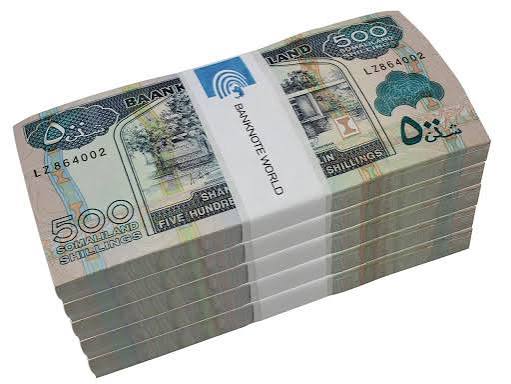
More Somaliland shillings are entering circulation. And communities are willing to accept or hold the currency, leaving Hargeisa and Burao to absorb much of the pressure.
HARGEISA, Somalia — The Somaliland shilling is losing ground as more people turn to the U.S. dollar and the currencies of neighboring countries.
The central problem is that fewer people are using the shilling, while more of it is being released into circulation.
In communities near Djibouti, many residents and businesses now prefer the Djiboutian franc or the dollar. Along the Ethiopian border, traders increasingly rely on the Ethiopian birr and the dollar; also, North East state uses the dollar. As a result, the shilling is being used mainly in Hargeisa, Burao and several nearby areas.
This leaves a smaller population carrying a growing supply of currency.
Many residents are also reluctant to keep their savings in shillings because they fear the currency could lose more value. Those who can exchange it for dollars do so, while traders raise prices to protect themselves from exchange-rate losses.
The result is a difficult cycle. As more shillings enter the market, demand for the currency falls, and prices rise. Families earning their income in shillings feel the impact most because their salaries no longer buy as much food, fuel or other essentials.
The situation has reminded some observers of the “Nafta” shilling once used in parts of northern Mogadishu. As fewer people accepted those notes, public confidence collapsed. The currency eventually lost most of its value and disappeared from everyday trade.
The Somaliland shilling has not yet reached that point, but the similarities are concerning. No currency can remain stable if its supply continues to increase while the number of people willing to use it continues to decline.
Unless the authorities slow the release of additional notes and rebuild confidence, the shilling could become increasingly confined to Hargeisa and Burao. For residents of those cities, that would mean higher prices, weaker purchasing power and greater uncertainty about the money they earn and save.