

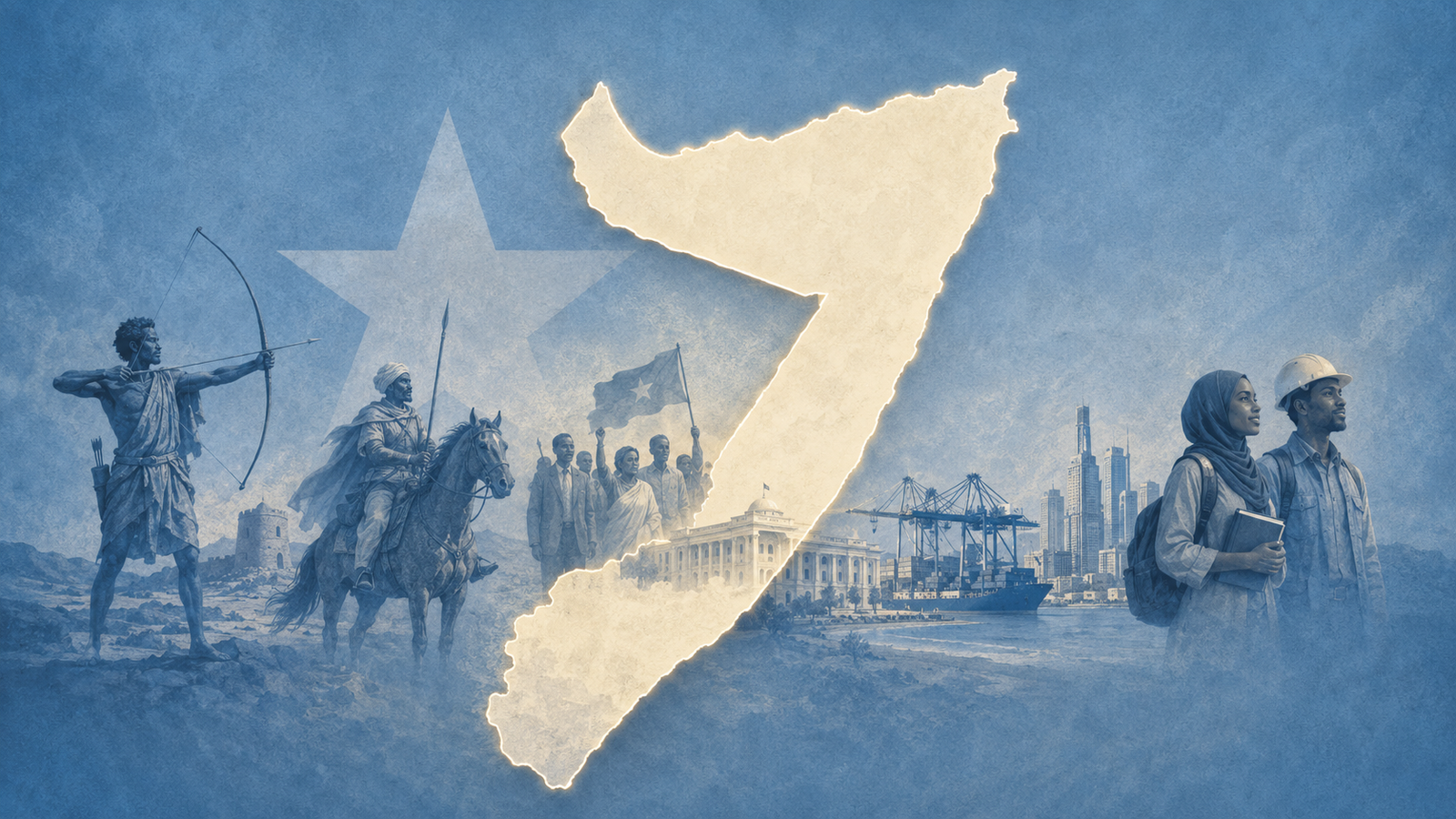
About 2,500 years ago, the Greek historian Herodotus recorded the story of Cambyses II, the king of Persia, and a distant people known as the Macrobians, a Greek name meaning “the Long-Lived People.”
According to Herodotus, Cambyses sent spies disguised as ambassadors before attempting to invade Macrobian territory. The Macrobian king recognized their true purpose and handed them a large bow. He instructed them to tell Cambyses that when the Persians could draw a bow of equal size as easily as he could, they might consider invading.
Cambyses ignored the warning and marched his army into unfamiliar territory without adequate supplies. Hunger and exhaustion devastated his forces, and the expedition ended in failure. The account appears in Book Three of Herodotus’s Histories.
Some later writers have placed the Macrobians in the Horn of Africa and connected them to ancient Somali populations, pointing to Herodotus’s descriptions of their height, strength and pastoral way of life. Their precise identity and location, however, remain disputed. No conclusive evidence proves that they were the direct ancestors of today’s Somalis.
The story matters here not as proof of Somali ancestry, but as a metaphor for a political lesson that appears repeatedly in Somalia’s documented history: foreign powers often mistake Somali division for Somali submission.
Somalis may become politically divided. Their country may pass through periods of disorder. But political arrangements perceived as foreign impositions rarely acquire lasting legitimacy..
Sovereignty Before the Modern State
Somali attachment to independence did not begin with the establishment of the Somali Republic in 1960. Long before European colonial rule, Somali territories were home to numerous sultanates, imāmates and commercial states, including Adal, Ajuran, Geledi, Warsangali and the Hiraab Imamate.
These political formations existed during different periods and governed in different ways. They were not modern nation-states, but their history shows that Somali territories were not a political vacuum waiting for outsiders to organize them.
When European colonial powers expanded into Somali lands, they encountered sustained resistance. The most prominent example was the Dervish movement, which fought colonial forces from the end of the 19th century into the early 20th century.
In 1920, British aircraft attacked Dervish fortifications in one of the earliest colonial campaigns in Africa in which air power played a decisive role. The Royal Air Force Museum records that British aircraft destroyed three Dervish forts within five days before supporting the advancing ground forces.
The Dervish struggle also included conflicts among Somalis, and its legacy remains contested. Nevertheless, it demonstrated the depth of Somali resistance to foreign rule.
A generation later, the Somali Youth Club, later renamed the Somali Youth League—pursued independence through political organization rather than armed rebellion. Founded in Mogadishu in 1943, the movement expanded across widely dispersed Somali communities and became central to the campaign for self-determination. Its members used public education, grassroots organization and appeals for national unity to mobilize support for independence.
The methods differed, but the central message remained the same: Somalis should determine their own political future.
Why Local Legitimacy Matters
Somalia’s modern political history also shows that institutions are more likely to endure when communities believe they participated in creating them.
Puntland, Somaliland and Galmudug are often cited as examples of administrations shaped through local political processes. Their histories, legal positions and levels of public acceptance differ considerably. None is free from political disputes or institutional weaknesses. But their experiences demonstrate the value Somalis place on consultation, negotiation and local ownership.
This does not mean that every institution created inside Somalia is automatically legitimate, democratic or effective. Nor does it mean that any Somali government receiving international support should be dismissed as foreign-made.
Somalia’s present federal institutions emerged from the end of the transitional period in 2012, through a process involving Somali political leaders, regional representatives and a new federal parliament. Yet memories of earlier transitional governments negotiated abroad continue to influence how many Somalis judge political authority.
The broader lesson is straightforward: legitimacy cannot simply be imported. It must be built through consultation, public acceptance, accountable institutions and visible service to the population. The real distinction is not between Somali and foreign. It is between partnership based on consent and authority imposed through coercion.
The Lesson of the 1992–1995 Intervention
When international forces entered Somalia in 1992, the country was suffering from civil war, state collapse and a devastating famine. The original purpose was to protect humanitarian assistance and save people threatened by starvation. Large quantities of aid reached civilians, and many lives were saved. Somalis had reason to appreciate that international effort.
It is equally important to acknowledge that Somali warlords looted humanitarian supplies, terrorized civilians and contributed substantially to the destruction and famine devastating the country. Honest history cannot tell only one side of the story.
Over time, however, parts of the humanitarian operation developed into coercive disarmament, political intervention and direct warfare against Somali factions. As the mission lost its perceived neutrality, many Somalis began to view international troops as combatants rather than humanitarian protectors.
American forces withdrew in March 1994, while the United Nations mission ended in March 1995. The U.S. State Department’s historical account concludes that the international intervention failed to produce a lasting solution to Somalia’s political crisis.
The lesson is not that every action committed by Somali armed factions should be defended. It is that when a humanitarian mission becomes a coercive political and military authority, public trust collapses and resistance grows.
The 2006 Intervention and Its Strategic Consequences
In late 2006, Ethiopian forces entered Somalia in support of the Transitional Federal Government. Within a short period, they removed the Islamic Courts Union from Mogadishu and other major cities.Militarily, it appeared to be a rapid victory. But military success and political success are not the same thing.
The presence of Ethiopian troops generated intense nationalist anger. Al-Shabaab, then a relatively small extremist faction, gained an opportunity to present itself as a force resisting foreign intervention. As documented by the International Crisis Group and other researchers, the intervention created conditions that helped Al-Shabaab expand its recruitment, propaganda and territorial reach.
But Al-Shabaab is not a liberation movement.
The organization has killed thousands of Somalis, bombed civilian areas, damaged the economy and targeted religious scholars, elders, health workers, soldiers and government officials. It exploited Somali nationalist sentiment, but it does not represent Somali sovereignty.
A movement that seeks to rule Somalis through fear cannot credibly claim to be defending their freedom.
The events of 2006 nevertheless offer a warning to outside powers: removing an opponent from a capital city is not the same as securing political legitimacy. When foreign intervention is perceived as occupation, even an extremist organization can exploit the resulting anger.
Somalia at the Center of a Geopolitical Contest
Somalia has one of Africa’s longest coastlines. Its shores face the Gulf of Aden and the Indian Ocean, alongside maritime routes connecting Asia, the Middle East, Africa and Europe. The country possesses strategically located ports, valuable fisheries, potential offshore energy resources and territory important to international shipping and regional security. Foreign governments are therefore not interested in Somalia out of compassion alone. Every country has interests of its own.
Ethiopia seeks reliable access to the sea. Gulf states compete for ports, trade and political influence. Türkiye has expanded its military training, security cooperation and economic involvement. The United States and other Western countries prioritize counterterrorism and maritime security. Egypt is concerned with the wider regional balance of power.
Not all these interests are hostile. Somalia needs investment, technical knowledge, international trade, security cooperation and dependable partners. Foreign doctors, teachers, investors and military trainers can contribute greatly when their work strengthens Somali institutions rather than replacing them. Every foreign relationship should therefore be judged by four principles: Somali consent, protection of national sovereignty, mutual benefit and transparency.
A country that respects Somalia works through its national institutions. A power seeking control attempts to bypass those institutions by dealing separately with political factions, federal member states or influential individuals.
The Ankara Declaration acknowledged the potential benefits of reliable Ethiopian access to and from the sea. It also stated that any arrangement must respect Somalia’s sovereignty, unity and territorial integrity and remain under its sovereign authority. That is the proper framework: cooperation based on mutual interests without undermining the Somali state.

The Truth Somalis Must Also Confront
Foreign actors cannot be blamed for every Somali failure.Outside powers rarely break down Somalia’s door alone; too often, a Somali hands them the key.
Clan rivalries, corruption, tensions between the federal government and federal member states, and weak national institutions create opportunities for external interference. When a Somali politician uses foreign support against another Somali, that politician surrenders part of the country’s decision-making authority.
When agreements concerning ports, natural resources or national security are hidden from the public, sovereignty becomes a decorative word in political speeches. When the government cannot collect sufficient revenue, protect its coastline or properly equip its security forces, other countries inevitably move into the vacuum.
Flags and fiery speeches cannot patrol a coastline. That requires a capable national military, functioning laws, domestic revenue, accountable institutions and a population united around the national interest.
Somalis have repeatedly demonstrated that they cannot easily be governed through force. But rejecting foreign domination is not, by itself, a complete victory. If the country remains fractured, its citizens remain poor and its territory remains vulnerable, the departure of foreign forces does not automatically produce genuine independence.
Sovereignty That Feeds Its People
A Somali proverb declares:
“Freedom with hunger is better than colonialism with a full stomach.”
It captures something fundamental about the Somali spirit: people would rather endure hardship under their own authority than live comfortably under someone else’s rule.
But this generation has a responsibility greater than repeating an old proverb.
Earlier generations endured hunger for independence. The present generation must transform independence into something that feeds the people, protects their security and preserves their dignity.
The message to every power interested in Somalia is simple: Somalia can be a partner, but it cannot be treated as a subordinate. Friendship is welcome, investment is necessary and security cooperation is important—but all must pass through the front door of Somali sovereignty.
The message to Somalis is more difficult: foreign powers cannot divide the country unless Somalis make their divisions available for purchase.
Genuine sovereignty means more than rejecting outside interference. It requires building a state that no foreign government, regional administration, political faction or private interest can bypass.
Before trying to reshape Somalia, understand the Somali people. The country can be wounded, but its people’s desire for freedom cannot easily be broken.


