
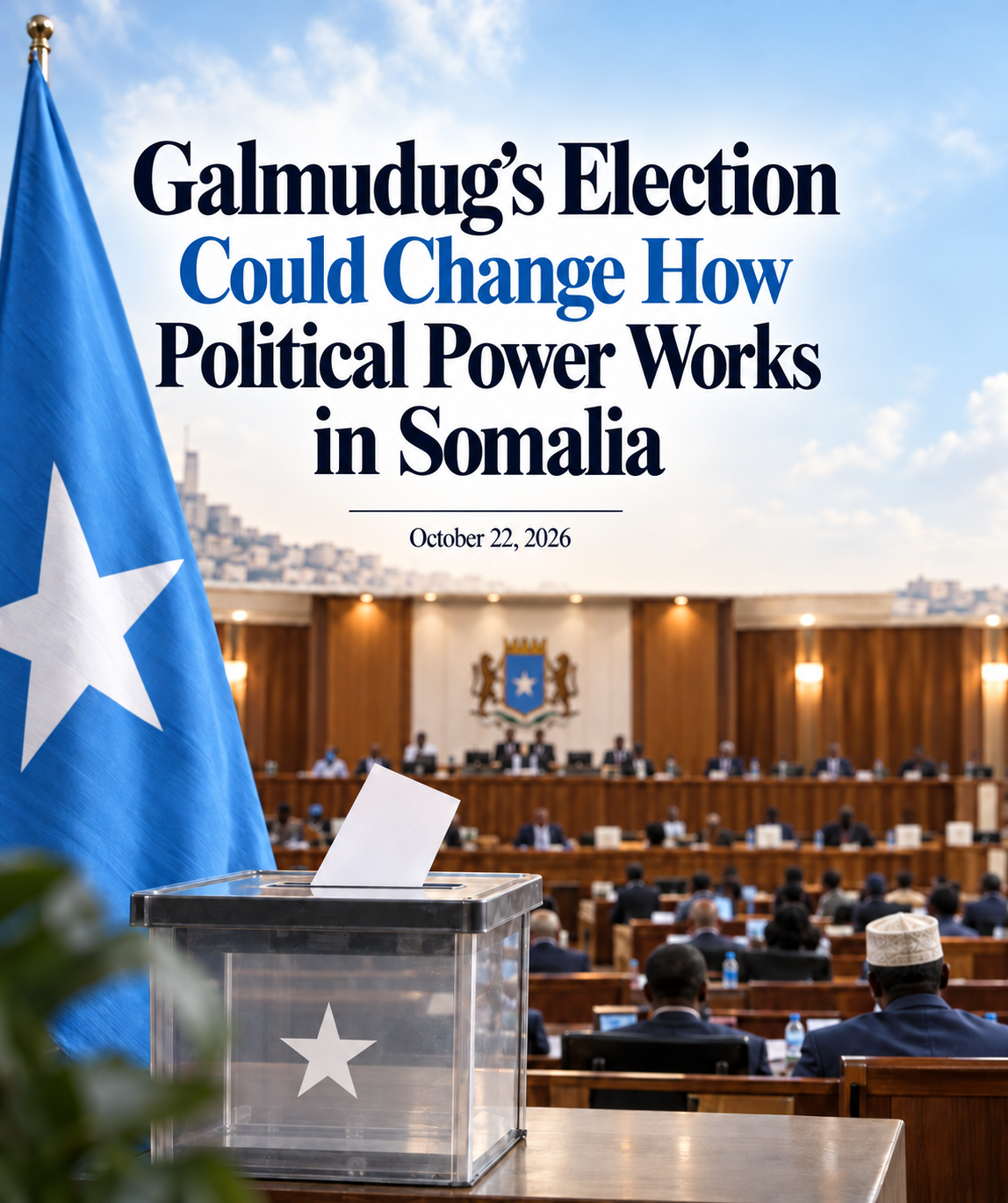
After decades of clan-based selection and political bargaining, lawmakers elected through a public vote chose Galmudug’s new leadership. The implications could reach far beyond the state.
By Osman Omar | October 22, 2026
DHUSAMAREB, Somalia — The election of Galmudug’s new president on October 22, 2026, may have consequences well beyond the state itself. For the first time under its new electoral system, Galmudug’s leader was chosen by a parliament whose members had been elected directly by the public, rather than selected through the traditional clan-based political process.
Liibaan Ahmed Hassan won the presidency with 72 votes from the 89-member parliament. His opponent, Abdulkadir Abdullahi Diriye, received 14 votes, while three ballots were invalid.
The result itself is only part of the story. What makes this election different is how the lawmakers reached parliament in the first place.
On September 30, voters across 11 Galmudug districts went to the polls to elect their representatives. About 149,475 people participated, giving political parties a chance to compete directly for public support.
Those elected lawmakers have now chosen the state’s new president.
For Somalia, where political representation has often depended on negotiations among clan elders, political figures, and influential groups, this introduces a different way of forming government.
The public did not directly elect Galmudug’s president, but voters elected the parliament that made that decision. That distinction matters because it changes the relationship between politicians and the people they represent.
A change in how politicians reach power
Since Somalia’s central government collapsed in 1991, the country has relied heavily on clan-based arrangements to rebuild political institutions.
Those agreements helped communities negotiate representation during years when functioning state institutions were largely absent.
But they also meant ordinary citizens often had little say in choosing their leaders.
For many politicians, gaining office required securing the support of clan elders, influential intermediaries, and a relatively small number of decision-makers.
Direct elections begin to change that calculation.
Candidates now have to consider the voters who elect their representatives. Political parties need local support, campaign organizations, and candidates who can persuade the public.
It does not mean clan influence will disappear. Clan identity remains an important part of Somali society and politics.
But it means clan endorsement is no longer the only route to political representation.
That may become one of the most important consequences of the Galmudug election.
What investigation found about election payments
Another aspect of this election deserves attention.
Based on information from my investigation, including sources familiar with the process and supporting evidence I have collected, lawmakers were not paid to vote in the October 22 presidential election.
This finding concerns payments intended to influence lawmakers’ votes. It does not mean the election, its administration, or political campaigns involved no expenses.
Vote-buying allegations have followed previous indirect political contests in Somalia. Political office has often been associated with private negotiations and financial influence.
My findings indicate that the Galmudug leadership vote took place without payments to lawmakers for their ballots. The supporting evidence has not been independently audited, but it provides an important account of how this election was conducted.
If this practice continues in future elections, it could change how politicians organize campaigns and seek office.
Instead of relying on payments to secure political support, candidates would have more reason to invest in party organization, political relationships, and public confidence.
That would not eliminate money from politics. But it could begin to change its role.
Why Galmudug matters to national politics
Galmudug has long been connected to Somalia’s national political debates.
Political figures from the region have served in federal governments, led reconciliation efforts, shaped security policy, and participated in negotiations over the country’s political system.
What happens in Galmudug is therefore closely watched by politicians elsewhere.
The September parliamentary election gave the Justice and Solidarity Party (JSP) 67 of the assembly’s 89 seats. The party subsequently secured the parliamentary leadership, and its candidate won the October presidential election.
These results show how political parties can use local elections to build influence at the state level.
They also raise a question for politicians across Somalia.
Will future leaders continue to depend primarily on agreements between influential individuals, or will they need political parties capable of winning elections?
If direct voting expands, politicians may have to build stronger relationships with communities and explain what they intend to deliver.
That could gradually shift campaign discussions.
Instead of concentrating mainly on which clan receives a position, candidates may face more questions about security, schools, roads, jobs, local services, and government performance.
For voters, that creates another possibility: holding elected representatives accountable when they fail to deliver.
The election also tested Somalia’s institutions
The path to the October 22 election was not without controversy.
The Supreme Court annulled Galmudug’s earlier July election following concerns about electoral procedures. The vote was repeated on September 30, and the court subsequently approved the new results.
The process showed that electoral disputes could be brought before a court and that a court could order an election rerun.
However, questions about political inclusion remained. The Towfiiq political organization challenged its exclusion from the rerun, raising concerns about whether all competitors had been given a fair opportunity to participate.
Those concerns remain relevant to the legitimacy of the broader electoral process.
An election needs more than ballot boxes and announced results. Political parties must trust the rules, electoral authorities must be accountable, and candidates need a credible way to challenge decisions.
Galmudug’s legal approval is significant, but long-term public confidence will depend on how those institutions perform in future contests.
What could change in Somali politics?
The consequences of Galmudug’s election will become clearer over the next several years.
One possible change concerns the role of political parties.
If more states adopt direct elections, parties will need to organize beyond Mogadishu and other major political centers. They will need candidates, local offices, members, and programs that voters can evaluate.
Another change concerns the next generation of politicians.
Young Somalis who grew up after the collapse of the central government may find more opportunities to enter politics through elections rather than relying entirely on established political networks.
The third change could involve the relationship between the federal government and member states.
State governments whose lawmakers have been elected by the public may increasingly base their political authority on that electoral mandate. This could strengthen elected institutions while also creating new debates over federal and state powers.
None of these changes is automatic.
Small groups could dominate political parties. Money could still influence elections. Clan alliances could continue to shape candidate selection, and disputed results could create new tensions.
The question is whether elected institutions can develop rules that survive leadership changes.
The bigger political question
Galmudug’s election does not mean Somalia has completed its transition to direct democracy.
The country still faces disagreements over electoral rules, federalism, political inclusion, and the role of traditional institutions.
But the October 22 election shows that a different political process is taking shape.
Voters elected a state parliament. That parliament elected a president. Political parties competed for seats, and the courts reviewed the process.
These developments offer other parts of Somalia a model to examine, including what worked and what needs improvement.
For decades, politicians often focused on securing the agreement of the people who controlled access to public office.
If direct elections become a regular part of Somali politics, that approach may no longer be sufficient.
Politicians will increasingly have to consider the people who vote for their representatives and who may later choose someone else.
That is the real significance of Galmudug’s October 22 election. It is not simply about who became president. It is about whether the people of Somalia are beginning to play a greater role in deciding who holds political power.
Whether this becomes a lasting change will depend on what happens in the next election—and the one after that.
