
There’s a difference between fighting a war and appearing to fight one.
A closer look at Somalia’s recent security leadership reveals two distinct patterns: territorial loss under previous command structures and territorial consolidation under current leadership. When examined in terms of operational outcomes rather than rhetoric, the contrast becomes difficult to ignore.
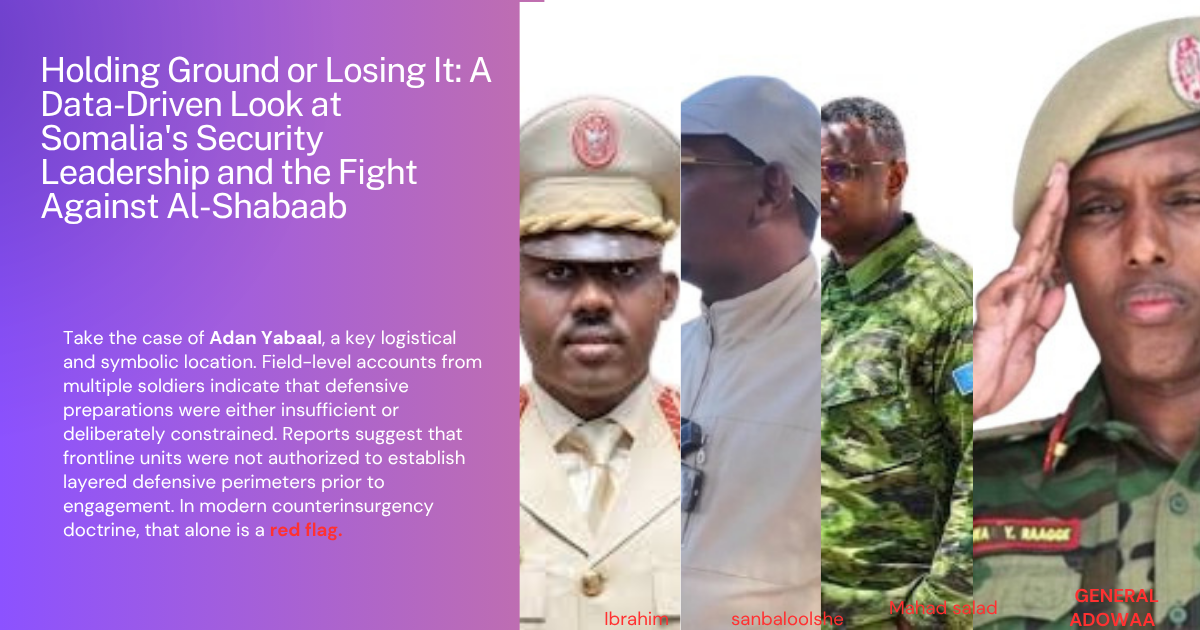
During the tenure of Abdullahi Sanbaloolshe and other dismissed commanders, such as former Somali national army commander General Odawaa, multiple strategically significant areas fell out of government control. Some of these locations were neither remote nor indefensible; they were populated, well-known, and, in some cases, deeply connected to those in leadership. The loss of such territory raises legitimate operational questions: were these withdrawals the result of tactical necessity, or indicators of deeper structural or command failures?
Take the case of Adan Yabaal, a key logistical and symbolic location. Field-level accounts from multiple soldiers indicate that defensive preparations were either insufficient or deliberately constrained. Reports suggest that frontline units were not authorized to establish layered defensive perimeters prior to engagement. In modern counterinsurgency doctrine, that alone is a red flag.
More critically, consistent testimonies from personnel describe limited engagement during the confrontation itself. Instead, smaller regional units, particularly forces originating from Galmudug, reportedly carried the burden of active combat, while larger national units remained under restrictive orders. While such claims require continued verification, the consistency across independent accounts suggests a pattern worth scrutiny.
Now contrast that with the current approach under Mahad Salad and General Ibrahim Mohamed Mahmoud Hassan
The operational doctrine appears to have shifted from reactive withdrawal to territorial denial and retention. Instead of conceding ground under pressure, current strategies emphasize holding captured areas and expanding state presence across contested regions.
A clear example is the corridor between Mogadishu and Marka—a historically vulnerable route. Open-source reporting and local accounts indicate that this road has faced repeated attempts, reportedly over twenty, by Al-Shabaab to disrupt access and reassert control. Each attempt has been met with resistance, and crucially, without a sustained loss of the route.
That’s not just a tactical detail—that’s a strategic signal.
In counterinsurgency warfare, success is not measured by isolated victories but by the ability to hold, secure, and normalize territory over time. Roads staying open. Supply lines are functioning. Civilians moving without constant fear. These are the metrics that matter. There are also credible reports that foreign contractors are on the ground examining whether these are my rare Earth minerals, such as bauxite and alumina, but have yet to confirm this report 
However, this is where the debate often goes off track.
Some argue that the current fight against Al-Shabaab is being politicized. But that argument itself needs grounding. If one period is marked by consistent territorial withdrawals, and another by repeated successful defenses of key infrastructure, then the discussion should move beyond politics and toward performance.
The reality is simple, even if uncomfortable:
War leaves footprints.
Territory lost is visible.
Territory held is measurable.
Patterns don’t lie—even when people do.
So before reducing the conversation to political narratives, it’s worth asking a harder question:
Are we judging leadership by what is said—or by what can be observed?
When you line up the timelines, locations, and outcomes, the picture becomes clearer.
And clarity, in a war like this, is everything.
