
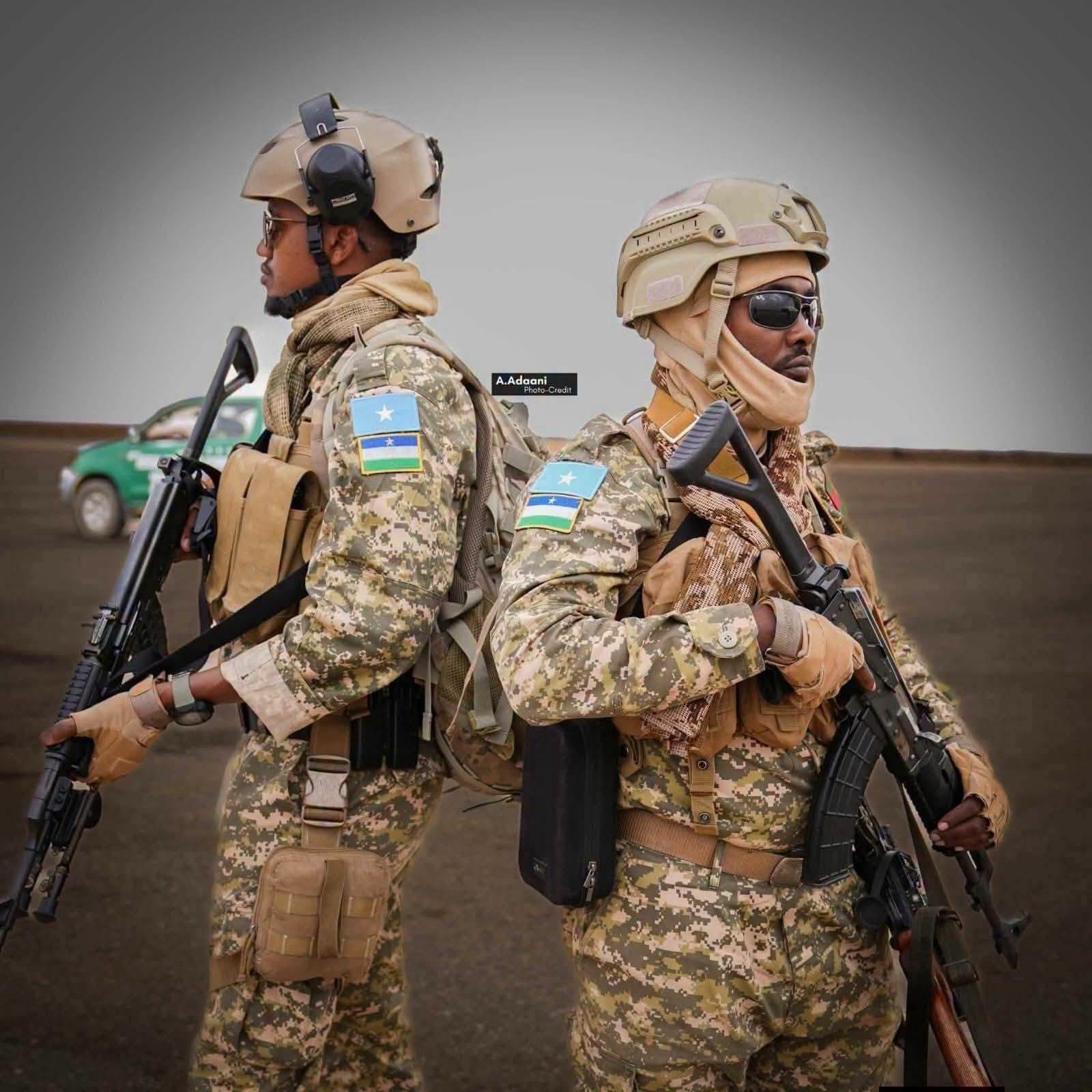
Fighting between Puntland forces and a historically U.S.-backed counterterrorism unit has exposed deep divisions over military command, political power and relations with Somalia’s federal government.
GAALKACYO, Somalia — Months of political tension inside Puntland, a federal member state of Somalia, erupted into open warfare on Wednesday when forces under the regional administration attacked a base occupied by the Puntland Security Force, commonly known as the PSF.
The fighting began before dawn near Abdullahi Yusuf International Airport in northern Gaalkacyo. Residents reported exchanges of mortar fire and heavy machine-gun rounds, forcing families to flee nearby neighborhoods and disrupting businesses and traffic across parts of the city.
At least one child was reportedly killed and his mother wounded when a mortar shell struck a residential area. The full number of military and civilian casualties remains unknown and has not been independently verified.
Puntland forces later seized the PSF compound. President Said Abdullahi Deni described the assault as a planned security operation intended to defend Puntland’s institutions from forces operating outside the regional chain of command.
But the confrontation is more complicated than the political slogans surrounding it.
The PSF is not an outside army newly deployed to Puntland. It is a counterterrorism force established in the early 2000s, rooted in Puntland and historically supported and trained by the United States. It has maintained a significant military presence in Bosaso and previously operated a base near Gaalkacyo’s airport. Its personnel have participated in campaigns against both Al-Shabaab and Islamic State militants.
Relations between the PSF and President Deni’s administration deteriorated after he took office in 2019. The dispute produced deadly fighting in Bosaso in 2021 and was never fully resolved. In recent months, disagreements over command, political influence and clan representation have again pushed the two sides toward confrontation.
The dispute has acquired a federal dimension because elements of the PSF have increasingly aligned themselves with Somalia’s federal government. Puntland authorities have accused Mogadishu of supplying, recruiting and directing forces inside the region without coordinating with the state administration. Federal officials, meanwhile, have presented some of these personnel as members of Somalia’s national security forces.
Those competing claims remain politically charged and institutionally unresolved.
For that reason, describing Wednesday’s fighting simply as a battle between “the Somali federal army and Puntland” goes beyond the publicly established facts. The combatants were Puntland forces and a security organization that originated in Puntland but whose current legal status and chain of command are disputed.
Calling the PSF “federal-aligned” may describe its present political relationship with Mogadishu. It does not, by itself, prove that Somalia’s federal army launched an attack against Puntland. That distinction matters in a country where political factions routinely turn contested loyalties into weapons of propaganda.
The deeper crisis is internal. Puntland’s political leadership has failed to settle a long-running dispute over who commands armed units operating within the region, how political power is shared and how regional security forces should relate to Somalia’s federal institutions. Those disagreements have now moved from conference rooms to military compounds.
Gaalkacyo is particularly vulnerable to such escalation. The city is divided administratively between Puntland in the north and Galmudug in the south and has endured repeated episodes of armed conflict. Any prolonged confrontation risks drawing in clan militias, widening the political dispute and destabilizing communities on both sides of the city.
The timing is also dangerous. Puntland’s forces are engaged in an important campaign against Islamic State militants entrenched in the Cal Miskaad mountains. Every soldier, vehicle and weapon diverted toward an internal power struggle weakens that campaign and creates an opening for extremist organizations.
Wednesday’s battle therefore represents more than a disagreement over one military base. It is a warning about what happens when political disputes are allowed to fracture security institutions: forces created to defend the public begin turning their weapons on one another, while civilians pay the price.
The immediate fighting may have ended, but the dispute that produced it has not. Unless Puntland and federal leaders establish a credible agreement on command, legal authority and political representation, weapons intended for counterterrorism will remain pointed inward, and Somalia’s enemies will watch from the hills.
