
Mogadishu; Somalia
Follow the Mandate—or Leave: Somalia’s Sovereignty Isn’t Optional
Somalia is no longer stuck in the ruins people remember. The country is moving, pushing back Al-Shabaab, reopening roads, rebuilding institutions, and proving that the federal government is no longer symbolic. But right in the middle of that progress, there’s a contradiction that’s too obvious to ignore. In cities like Kismayo, Baydhabo, and Jowhar, African Union forces are present, yet the authority of the federal government doesn’t fully apply. Local leaders operate with protection but without full accountability to Mogadishu. That’s not stability. That’s a system working against itself.
And people are starting to ask the real question: if one group blocks the government through violence and another operates outside it under external protection, what’s the difference in outcome? Strip away the politics—the result looks the same. A government that cannot fully govern. A nation divided in practice. This is where the double standard becomes dangerous. The Somali government is expected to unify the country, yet in key المناطق its authority is quietly limited—not by insurgents, but by the very structure of international support.
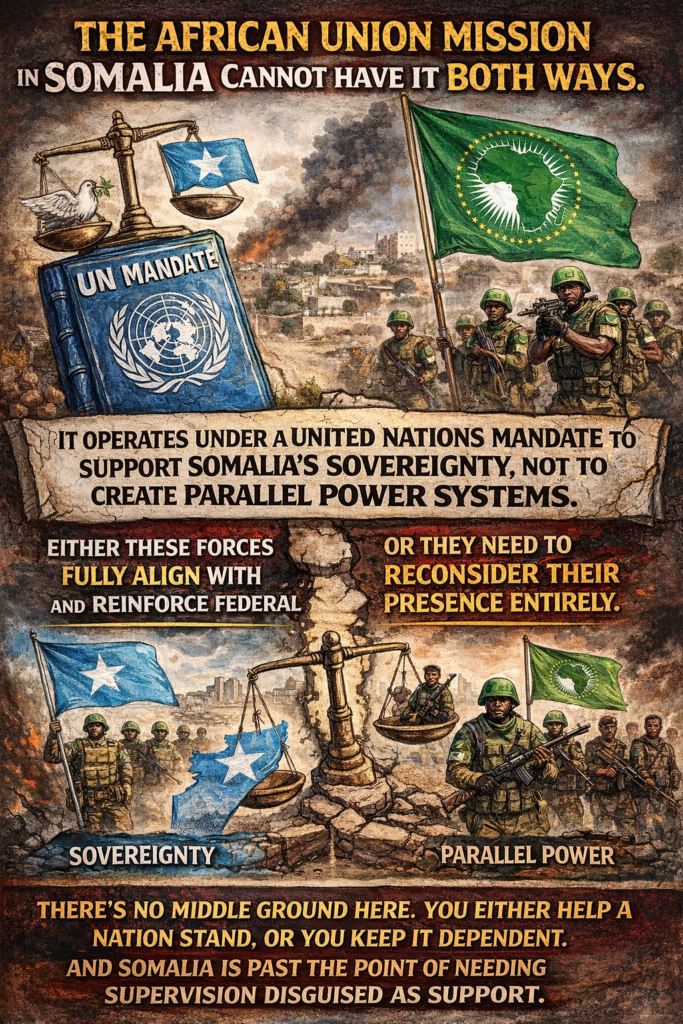
The African Union mission cannot have it both ways. It operates under a United Nations mandate to support Somalia’s sovereignty, not to create parallel power systems. So the line has to be drawn clearly: either these forces fully align with and reinforce federal authority across all regions, or they need to reconsider their presence entirely. There’s no middle ground here. You either help a nation stand, or you keep it dependent. And Somalia is past the point of needing supervision disguised as support.
At the same time, Somalia already has what many countries wait decades to build—a functioning center. Mogadishu is stable, active, and now the economic engine of the nation. No other region can match its economic weight today. That matters because real nations rebuild from strong centers outward. This is the moment to bring everyone together, clans, leaders, scholars, and civil society, into one national constitutional convergence in Mogadishu. It won’t be quick. It won’t be cheap. But for the first time, the economy can sustain both the government and the process of building a system all Somalis can agree on.
Somalia has seen what fragmentation costs. It doesn’t need another version of it dressed in a new language. The opportunity now is rare: end the era of political warlords, unify authority, and build a system that actually holds. But that requires honesty and clarity, from both Somalia and those operating inside it.
Follow the mandate or leave. Because sovereignty isn’t something you negotiate in pieces. It’s something you either own—or slowly lose.
