
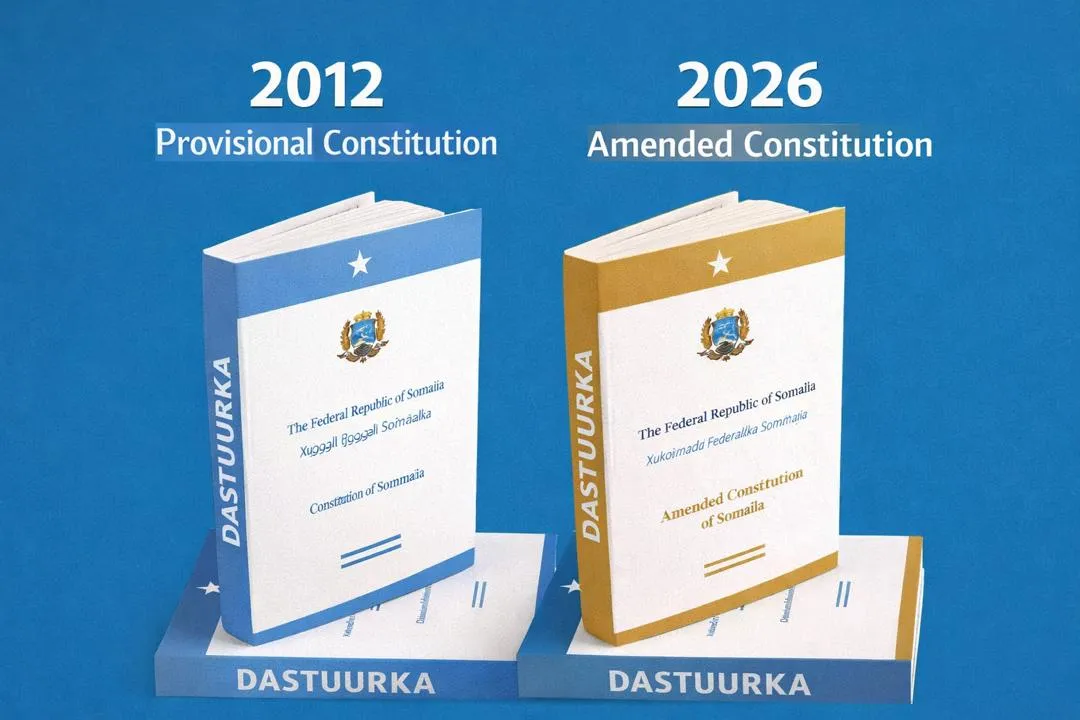
Somalia is once again arguing about its constitution. Opposition leaders warn that the latest amendments threaten legality and risk creating competing political frameworks. They describe the moment as a potential constitutional crisis.
Somalia has lived through enough political turmoil that such warnings cannot simply be dismissed. A constitution matters, especially in a country still rebuilding from decades of collapse.
But anyone looking closely at the current debate can see that something deeper is unfolding.
This is not only a legal argument.
It is a struggle over political power in a country that has quietly begun to change.
For more than a decade, Somalia has operated under the 2012 Provisional Constitution, drafted during a moment when the state itself was barely functioning. It was designed as a temporary arrangement — a bridge between collapse and reconstruction.
Yet like many temporary political systems, it became permanent.
Over time, Somalia’s political order settled into a familiar pattern: indirect elections, negotiations among elite political figures, and complicated clan-based bargaining. Power often flowed through agreements between political actors rather than through broad public legitimacy.
Many of the politicians who today oppose constitutional reform built their influence within that structure.
It is therefore not surprising that any attempt to change the system triggers fierce resistance. Political systems rarely evolve without unsettling those who benefited from the previous arrangement.
But the country itself is not standing still.
Somalia today is not the Somalia of 2012.
For the first time since the collapse of the Somali state in 1991, the federal government has begun to develop something Somalia long lacked: institutional capacity. That phrase may sound technical, but its meaning is simple. The state is slowly learning how to function again.
Nowhere is that more visible than in Mogadishu.
Not long ago the capital was defined almost entirely by insecurity. Bombings were frequent. Entire districts felt beyond the reach of authority. Public life existed under a constant shadow.
Today the picture, while still fragile, is noticeably different.
Markets are active. New buildings rise across the city. Restaurants and businesses operate in neighborhoods that once emptied before sunset. The rhythm of daily life — commerce, construction, movement — has returned in ways that would have seemed unlikely only a few years ago.
In the past, such changes might have remained invisible to the outside world. But the digital age has erased that distance.
Somalis inside the country share their reality daily through social media. Images of busy streets, new developments, and ordinary urban life circulate constantly online. These digital glimpses tell a story that does not always match the image of permanent collapse that still shapes some political narratives.
Economic activity in Mogadishu and other cities has expanded in recent years. Investment in real estate, trade and services has grown. The improvement is uneven and fragile, but it is visible enough to influence public perception.
And perception matters.
For many Somalis, the most convincing political argument today is not rhetoric but results.
One sign of this shift is the growing cooperation between citizens and Somali security forces. For years, distrust defined that relationship. Communities often saw state security institutions as weak or distant.
Now, in many areas, cooperation has increased. Citizens share information. Communities support security operations. Stability, though still incomplete, is increasingly a shared effort.
That level of public cooperation rarely emerges without some degree of trust.
At the same time Somalia’s politics contain another complicated reality: many opposition figures operate largely from outside the country and hold foreign passports.
The Somali diaspora has played an essential role in rebuilding the nation. Its financial and intellectual contributions are undeniable.
But politics inside Somalia is shaped by daily experience. For citizens living within the country, politicians who spend most of their time abroad can sometimes appear disconnected from the realities on the ground.
Whether fair or not, that perception influences credibility.
And increasingly, ordinary Somalis evaluate politics through a simple lens: what is actually changing in their lives.
Security.
Economic opportunity.
Functioning institutions.
These are the measures that matter.
This is why the constitutional debate cannot be understood solely as a technical dispute over legal procedure.
Opposition leaders argue that constitutional reform without full consensus risks destabilizing the country. Somalia’s history certainly contains examples of political decisions that deepened divisions.
But the alternative — preserving the current provisional system indefinitely until every political actor agrees — carries its own danger.
A political system where every stakeholder holds veto power over reform can become trapped in permanent negotiation.
Somalia has spent more than a decade operating within a constitutional framework designed for a transitional moment. A state cannot remain permanently transitional.
At some point, institutions must move beyond elite bargaining and begin functioning as durable structures of governance.
That is the real question beneath Somalia’s constitutional debate.
Will the country continue operating within a political system shaped primarily by negotiation among political elites?
Or will it gradually build a more stable order anchored in functioning national institutions?
For many ordinary Somalis, the answer feels increasingly clear.
They are tired of endless cycles of political bargaining. They want a state capable of providing security, supporting economic growth, and governing with some degree of predictability.
For the first time in decades, Somalia may be developing the institutional foundations necessary to move in that direction.
That reality changes the political equation.
The debate unfolding today is therefore not simply about constitutional clauses.
It is about whether Somalia is ready to move beyond the long shadow of its transitional era — and whether the political system will adapt to a country that is no longer the Somalia it once was.
